Laguna's Peter Kwee: homes hidden in a child's name go to her lenders
Peter Kwee, described by The Straits Times as the motoring tycoon who owns Laguna National Golf Resort Club, bought five properties between 1995 and 2000 in his daughter's sole name and ran them as his own, on nothing but his word. When she was made bankrupt in 2022 he asked the courts to declare them his. On 18 November 2026 the Court of Appeal agreed that they had always been his, and refused him anyway: he had meant to hide them from his creditors, and a trust set up for that purpose is void. Her creditors keep them.
Read this in: EN · 简体 · 繁體 · ไทย · ID
A father buys five homes in his daughter's sole name from 1995 to 2000, and writes nothing down
Peter Kwee Seng Chio has bought and invested in property for decades; The Straits Times has described him as a motoring tycoon and the owner of Laguna National Golf Resort Club. Between 1995 and 2000 he bought five properties in the sole name of his daughter, Karen Kwee Hui Ling: King's Drive and Teneriffe in Singapore, West Georgia and Lord Stanley in Canada, Spyglass Grove in Australia. He paid; she signed. Before each purchase, he said, he told her: 'It is mine. I will manage the property… After I die already, it is yours. I will see how to split assets within the family.' He called it a name placing agreement. Nothing was written down.
The father borrows against the homes for 20 years, then admits he hid them from estate duty and creditors
For two decades he ran the portfolio as his own. He refinanced Teneriffe for a larger loan in 2005, had a second mortgage taken on Spyglass Grove in 2009 for his business, and in 2010 sold Claymore, another property in her name, to pay down his debts. Asked at trial why the properties were in her name, he gave four reasons: avoiding disputes between his children, help with managing them, estate duty, and keeping them from his creditors. 'Those properties I bought during the estate duty is affected,' he said, 'so I put under Karen's name; if anything comes to me, there is no estate duty.'
The daughter borrows S$4.1 million in 2020, goes bankrupt in 2022, and a trustee takes the homes
The arrangement held until the daughter's own finances failed. In February 2020 she and her then husband borrowed S$4.1 million from two lenders; she says she was forced and misled into signing and did not read the agreement. That September she also signed an option to sell King's Drive to a friend of her husband, without telling her father. An arbitration award and a statutory demand followed. Eight days after the demand, on 20 May 2022, Mr Kwee lodged caveats on the two Singapore houses. She was adjudged bankrupt on 6 October 2022, and Mr Lai Seng Kwoon became her private trustee in bankruptcy, holding what she owned for her creditors.
The Court of Appeal rules the homes were always the father's, then voids his trust on 18 November 2026
Mr Kwee sued to have the properties declared his. In March 2025 Justice Philip Jeyaretnam held they were gifts to his daughter. On 18 November 2026 the Court of Appeal disagreed on the facts: he had paid, decided and controlled for decades, so she held them for him under a common intention constructive trust. Then it held that trust void. He had meant to conceal his ownership from his creditors, and a trust set up for that purpose is illegal and contrary to public policy, a question the court said it had never definitively decided. The properties stay in her bankruptcy estate, and he pays S$80,000 in costs.
The failure was not that a father put homes in his daughter's name. It was that the arrangement worked only while nobody could see it. Mr Kwee kept ownership and wrote nothing down, so his claim rested on his own account of why, and his account included hiding the properties from his creditors and from estate duty. The Court of Appeal accepted the homes were his and refused to enforce the trust for exactly that reason. The secrecy also left his daughter alone on titles she did not control, exposed to debts of her own. Once she was bankrupt, the appearance he had built for others was the one her creditors were entitled to.
A parent who wants a child to hold a home for him must do it in the open and while everyone is solvent: a signed, dated and stamped declaration of trust, for a reason that would survive being read aloud in court. A home placed in a child's name to hide it from creditors cannot be recovered at all.
Singapore's top court now voids any trust made to hide a parent's assets, even an unwritten one
This happened in Singapore, so the model answer starts from the law the Court of Appeal has just stated. A trust set up for the purpose of concealing the owner's assets from creditors is illegal and contrary to public policy, and void and unenforceable without more ([2026] SGCA 45 at [104]–[123]). The rule reaches trusts the law implies from conduct, not only written ones (at [109]). Coming clean later helps only if the withdrawal is genuine and voluntary; one forced by a bankruptcy is neither (at [93]–[95], [195]). The ruling turned on the creditor purpose, not on his other stated reasons, sparing his children disputes and having help with management (at [155], [193]).
A parent who signs a declaration of trust keeps the home; a deed of gift makes it the child's
The first decision is the one this family never made out loud: is the home a gift, or is it held for the parent? A gift can be recorded in a deed of gift, and then it belongs to the child, with her lenders and her marriage able to reach it. If the parent means to keep it, the Civil Law Act 1909, s7(1), requires a declaration of trust over immovable property to be manifested and proved by signed writing. Section 7(3) leaves constructive trusts outside that rule, which is how Mr Kwee proved his at all: after a trial and an appeal. The High Court noted his interest 'was never reflected in writing' ([2025] SGHC 46 at [2]).
A declaration stamped at S$10 the day it is signed leaves a dated record nobody can call concealment
The second step is to stamp it when it is signed. IRAS's buyer's stamp duty page, last updated on 9 October 2026, charges a fixed S$10 on a declaration of trust that does not change the beneficial interest in a property, and ad valorem duty where it does; a gift by voluntary declaration of trust is dutiable. For residential property held on trust, IRAS lists ABSD (Trust) of 65%, refundable for identifiable individual beneficiaries if the remission is applied for within six months (page last updated 14 August 2026). Which charge applies turns on the facts. Our reading: a dated, stamped declaration is hard to call concealment.
A family that settles who owns which home while everyone is solvent keeps it out of a bankruptcy court
The third step is the reason, and the time. Holding a home in a child's name to manage it, or to keep the peace between children, is a lawful choice. Holding it there so the parent's own creditors cannot reach it is what the court refused to enforce. Separately, the Insolvency, Restructuring and Dissolution Act 2018 lets a court undo a transfer at an undervalue made to put assets beyond a claimant's reach (s438), or a gift made within three years before a bankruptcy application by a giver who was insolvent or made insolvent by it (ss361, 363). So act while everyone is solvent. Estate duty is gone for deaths on or after 15 February 2008; whether older trusts made to evade it are void, the court left open (at [124]–[127]).
A trust with an independent trustee lets the child live in the home, and her own lenders cannot take it
The last step protects the child, because she carries the title. If the family's aim is a home the child can use but her own creditors cannot take, the instrument is a trust with an independent trustee under which she benefits without owning, not her bare name. Be plain about the limits. None of this rescues an arrangement already made to defeat creditors; the court rejected regularisation that came only under pressure (at [195]). It cannot stop a child signing what she should not; it only makes the record show the home was never hers to sell. This is a counterfactual drawn from the judgments, not advice.
Peter Kwee — an enforceable, recorded interest in the homes he paid for, at the price of stamp duty and of being visible, instead of a trust held void, five properties lost and S$80,000 in appeal costs on top of S$195,283.29 at trial (our addition of the two High Court orders)
Karen Kwee, the daughter on the title — a written statement of what she held and could not sell, which her lenders could also see, instead of titles she did not control, a bankruptcy since 6 October 2022 and a public trial about her family's arrangements
Her creditors — a clear view of what she owned before they lent; on the record as it stands, they take the five properties and most of the money in three bank accounts through her bankruptcy estate
Mr Kwee's own creditors over the years — the true picture of his assets, which is what the court's rule protects; it calls them the very class of persons the rule exists for (at [122])
The rest of the family — a will saying who receives what, instead of a promise to 'see how to split assets within the family' that bound nobody
A counterfactual, not advice: real structures need licensed hands and your family's facts.
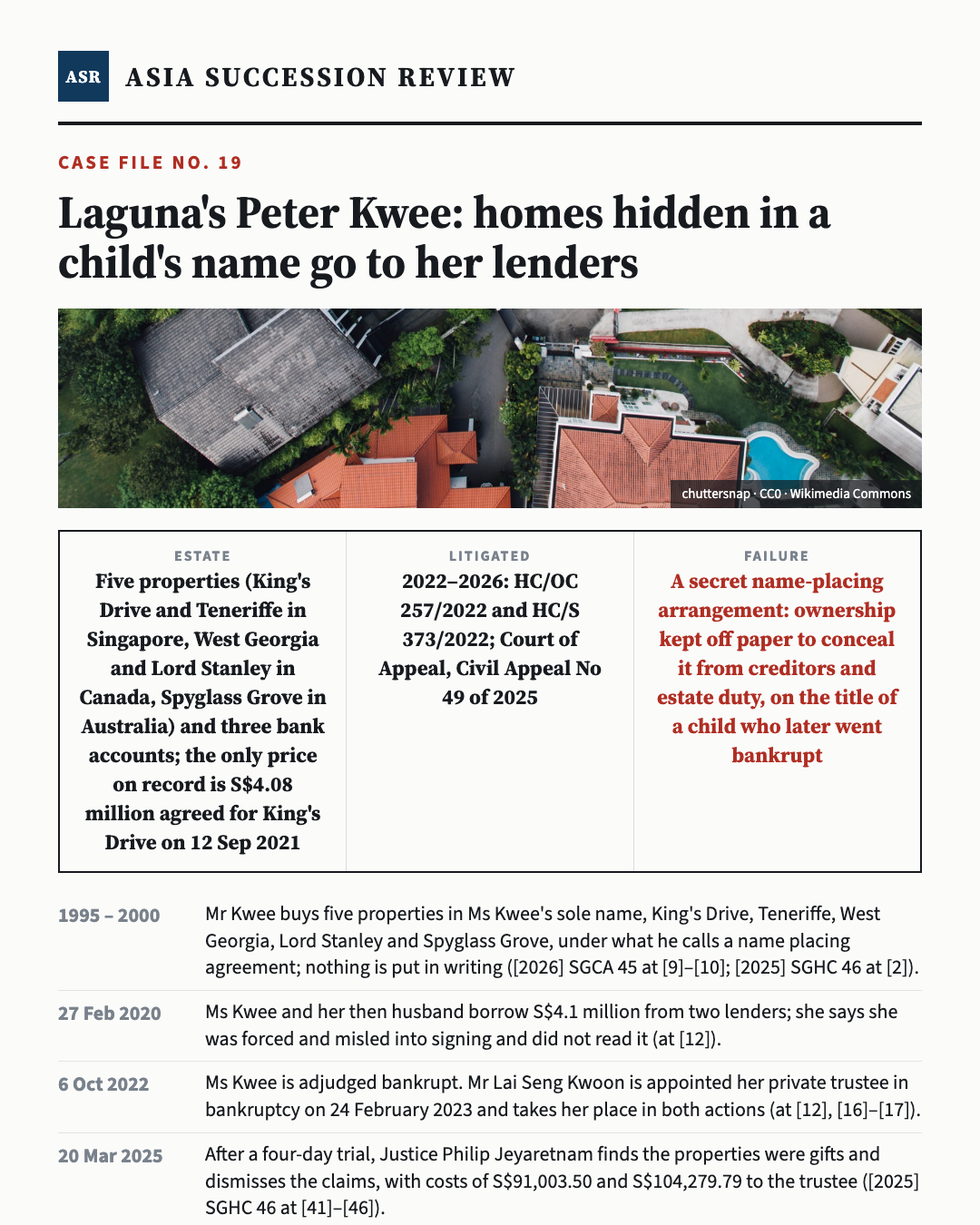
The case in one card — press and hold to save, or forward it as it is.
If a family home is held in someone else's name
Many families keep property in the name of a child, a sibling or a spouse, often for reasons that made sense decades ago. The questions worth asking while everyone is solvent are plain. Whose is it: a gift, or held for someone else? Is there a signed, dated and stamped page that says so? Would the reason it is in that name survive being read aloud in court? And if the person on the title borrowed money tomorrow, could the lender see the arrangement, or only the family? None of this is an accusation. It is how a family makes sure the person on the title is not left carrying a secret that is not theirs.
Who is Peter Kwee?
Peter Kwee Seng Chio is a Singapore businessman who, the Court of Appeal noted, has bought and invested in property for decades ([2026] SGCA 45 at [9]). The Straits Times has described him as a motoring tycoon and the owner of Laguna National Golf Resort Club. On 18 November 2026 he lost his appeal over five properties held in his daughter's name.
What was the Peter Kwee court case about?
Whether five properties and three bank accounts in the name of his daughter, Karen Kwee, belonged to him or to her bankruptcy estate. He said she held them on trust for him; her trustee in bankruptcy, Lai Seng Kwoon, said they were gifts. The High Court found gifts in March 2025. The Court of Appeal found a trust, then held it void.
Why did Peter Kwee lose if the court agreed the homes were his?
Because he had meant to conceal his ownership from his creditors, and his own written case conceded he 'sought to conceal the real ownership'. The Court of Appeal held that a trust set up to conceal assets from creditors is illegal and contrary to public policy, and therefore void and unenforceable ([2026] SGCA 45 at [104]–[123], [161], [193]).
Can a parent put property in a child's name and still own it in Singapore?
Yes, if the arrangement is honest and provable. Under s7(1) of the Civil Law Act 1909 a declaration of trust over immovable property must be proved by signed writing; a trust implied from conduct can also arise, as one did here. What the court will not enforce is an arrangement whose purpose is to hide the property from the parent's creditors.
Does a declaration of trust over a Singapore property attract stamp duty?
Yes. IRAS (page last updated 9 October 2026) charges a fixed S$10 on a declaration of trust that does not change the beneficial interest, and ad valorem duty where it does. For residential property held on trust, ABSD (Trust) is 65%, with a refund route for identifiable individual beneficiaries applied for within six months (14 August 2026).
Is a trust made to avoid estate duty still void now that estate duty is abolished?
Undecided. Estate duty was removed for deaths on or after 15 February 2008. Mr Kwee also aimed to evade it, but the Court of Appeal did not need to decide whether such a trust is void, and set out arguments both ways: illegal from the start, or judged by today's policy ([2026] SGCA 45 at [124]–[127], [193]).
Can a parent get the property back by coming clean later?
Only if the withdrawal is genuine and voluntary. The Court of Appeal rejected Mr Kwee's plea: selling Claymore in 2010 to pay creditors was financial necessity, and he disclosed the trust only because of his daughter's bankruptcy. A step forced by circumstances does not count ([2026] SGCA 45 at [93]–[95], [194]–[195]).
What happens to property in a bankrupt child's name in Singapore?
On a bankruptcy order the bankrupt's property vests without any transfer and becomes divisible among her creditors (Insolvency, Restructuring and Dissolution Act 2018, s327(1)(a)). Property she genuinely holds on an enforceable trust for someone else is not hers to divide. Here the trust was unenforceable, so the five properties stayed in Karen Kwee's bankruptcy estate.
A question of your own that these don't answer — put it to the desk.
- 1Kwee Seng Chio Peter v Lai Seng Kwoon [2026] SGCA 45 (Court of Appeal, 18 Nov 2026; Civil Appeal No 49 of 2025), read in full on eLitigation 21 Nov 2026: name placing agreement [9]–[10], loan and bankruptcy [12], caveats [16], [174], illegality rule [104]–[123], estate duty left open [124]–[127], purposes [155]–[162], control [166]–[168], trust [188]–[192], void [193], locus poenitentiae [195], costs [200]
- 2Kwee Seng Chio Peter v Lai Seng Kwoon [2025] SGHC 46 (Philip Jeyaretnam J, 20 Mar 2025), read in full on eLitigation 21 Nov 2026: 'never reflected in writing' [2], estate duty testimony [28], creditors [29], caveats [32], S$4.08m King's Drive price of 12 Sep 2021 [36], gift finding [41], costs S$91,003.50 and S$104,279.79 [46]
- 3Civil Law Act 1909, s7 (trusts respecting immovable property must be manifested and proved by signed writing; resulting, implied or constructive trusts unaffected), read on Singapore Statutes Online 21 Nov 2026
- 4Insolvency, Restructuring and Dissolution Act 2018, ss327 (effect of bankruptcy order), 361 and 363 (transactions at an undervalue; three-year relevant time; insolvency presumed for associates) and 438 (transactions defrauding creditors), read on Singapore Statutes Online as at 21 Nov 2026
- 5IRAS, Buyer's Stamp Duty (page last updated 9 Oct 2026, read 21 Nov 2026): gift including a voluntary declaration of trust is dutiable; fixed S$10 on a declaration of trust that does not change the beneficial interest
- 6IRAS, Remission of ABSD (Trust) (page last updated 14 Aug 2026, read 21 Nov 2026): ABSD (Trust) of 65%; refund for identifiable individual beneficiaries; application within 6 months of execution
- 7IRAS, Estate Duty ('Estate Duty has been removed for deaths on and after 15 February 2008'), read 21 Nov 2026
- 8The Straits Times via The Star (ANN), 20 Mar 2025 (secondary, for the description only): 'motoring tycoon Peter Kwee', owner of Laguna National Golf Resort Club; two landed properties in Bukit Timah, three overseas