Shin Kong: silence settles nothing, and a 1986 estate is back in court
吳火獅 (Wu Ho-su), founder of Shin Kong, died in 1986. On 30 October 2024, after a fight that began in January 2005, Taiwan's Supreme Court closed the case that makes 陳子婷 (Chen Tzu-ting), born outside his marriage, legally his daughter. His six children had stayed away from two court-arranged DNA tests, and the judges weighed that against them. She has since sued them for a share her side puts at NT$6.72 billion. What she can reach depends on what was divided, and when, and nobody has shown that in public.
Read this in: EN · 简体 · 繁體 · ไทย · ID
A Shin Kong founder dies in 1986, and a daughter born in 1984 appears on no paper
吳火獅 (Wu Ho-su), founder of the Shin Kong group, died on 18 October 1986. His heirs were his widow, 吳桂蘭, and six children: 吳如月, 吳東進 (Eugene Wu), 吳如英, 吳東賢, 吳東亮 (Thomas Wu), now chairman of TS Financial Holding, and 吳東昇. 陳子婷 (Chen Tzu-ting) was born in August 1984 while her mother was married to another man, so the law presumed that man her father. The first courts held that Wu therefore could not have recognised her while he lived. No judgment we read mentions a will, and nothing on the public record shows a document naming her.
A chairman pays NT$300,000 every three months for years, and the receipts later help prove her claim
The first talks the High Court records came in August 2001, at a legislator's office. From about 2006 money reached her through 李峰遙 (Li Feng-yao), then chairman of Shin Kong Security: NT$300,000 every three months, against receipts for 'sponsored' school and living costs. It stopped in 2011. That July, on a recording, he said nothing could be done in the short term: 'Mother is here', which her mother told the court meant the siblings' mother. The siblings denied authorising him; the 2023 court accepted that he acted for them. By that court's count he declined seven summonses, citing age and health.

The daughter sues twice across 19 years, and the six who skip two DNA tests lose in 2024
She sued in January 2005 and lost: she could not prove Wu had raised her, and the suit became final on 21 May 2007. Two days later the amended Civil Code let a child sue a dead father's heirs. She sued again on 1 June 2012. DNA sessions were fixed for 2 April 2014 and 1 June 2015; she attended and the siblings did not. She won at Shilin in 2014 and the High Court in 2015, lost there in 2018 and 2020, and the Supreme Court set aside all three High Court rulings. She won on 10 May 2023, and on 30 October 2024 the Supreme Court ended the appeal.
She claims one-eighth at Shilin in 2025, and the two sides swap stories about a 2004 division
Recognition settled who she is, not what she gets. In June 2025 she sued the six at Shilin; her lawyer says her share is one-eighth and put it at NT$6.72 billion. Mediation ended in minutes on 25 September 2025. In 2015 it was she who said the estate had been divided, on 23 November 2004, and the family who denied any such agreement. Now her lawyer says it was not divided, and unnamed sources told Mirror Media the family will say it was. On the Supreme Court's 2014 ruling, that question largely decides what she can reach. As at 7 November 2026 no ruling in the suit is public.
Everyone in this record stayed silent in a different way, and no silence closed the matter. No public document names her. Money moved through an executive against receipts, with no release, and the receipts helped prove her claim. The siblings stayed away from a test the High Court called quick and simple, and it inferred they preferred the cost of process to an adverse result. The courts have now said who she is. On what she gets, Taiwan protects what same-rank heirs took in good faith and leaves open what stayed undivided or surfaces later. The fact that matters most, what was divided and when, is still not public.
Put the name on paper before the funeral decides: a founder can provide for a child by will or trust even where he cannot recognise her, heirs can settle with a test, a sum and a release, and a signed record of what was divided closes what is still open here after 40 years.
Singapore gives a child born outside marriage nothing without a will, so Taiwan's 2007 law serves her better
Start with what Singapore would not do for her. With no will, Singapore's intestacy shares go to the lawful spouse and to children the Intestate Succession Act 1967 recognises, and a child born outside marriage is not among them. In AAG v Estate of AAH [2009] SGCA 56 the Court of Appeal held that two such daughters could not claim maintenance from their father's estate, though his name was on their birth certificates. It urged reform; section 2 of the Inheritance (Family Provision) Act 1966, as at 5 November 2026, still has no such wording. Taiwan's art 1067 gave her a road Singapore does not.
A Taiwanese founder sets up a trust in Singapore, and Taipei's one-sixteenth share for a child still applies in Taiwan
Nor would a Singapore structure simply override Taiwan. Succession follows the deceased's nationality, and a Taiwanese heir can inherit assets in Taiwan under Taiwanese law (涉外民事法律適用法 art 58). So a Taiwanese founder's Taiwanese land and shares stay under the Civil Code, with its forced share: half a child's statutory share (art 1223), one-sixteenth here on our arithmetic. Trustees Act 1967 s90 shields a lifetime trust from inheritance rules only if Singapore law governs it, its trustees are resident here and the settlor is neither a citizen nor domiciled here. Our reading: that binds a Singapore court, not a Taipei one.
A founder who cannot recognise a daughter names her in one dated will, and his six heirs get a number
The lever the founder had was paper. He could not recognise her, the first courts held, but no rule stopped him naming her. In Taiwan a will may dispose freely within the forced shares (art 1187). A Singapore will has no forced shares for a non-Muslim, so a named gift reaches a child the intestacy rules ignore. A lifetime trust does more: assets pass outside probate, instructions stay private, and the settlor can keep investment powers (s90(5)). One dated document with her name and a sum would have given her a beneficiary's rights, and his six children a known number.
Six heirs sign one deed on a test, a sum and a release in 2001, and nine rulings never happen
The siblings had a lever too. From the first talks on record in 2001, a deed could have fixed three things: a test, a sum and a mutual release. If the test excluded her, the matter ended there; if it confirmed her, the family set the price instead of a court. Instead, support ran for years with no release, and the receipts and bank books became evidence. A deed of family arrangement is a private document. Nine rulings are not.
Heirs keep a signed inventory of every division, and a 2026 court stops asking what happened in 1986
Last, keep the record of division. In Taiwan a child recognised after the father's death cannot reach what same-rank heirs have already taken in good faith, but can reach what stayed undivided or is found later (Supreme Court, 2014 and 2021). That makes a signed, dated inventory the most valuable paper in an old estate. Whether this estate has one, we do not know. A counterfactual is not advice, and it decides nothing about the suit at Shilin.
陳子婷 (Chen Tzu-ting) — a named provision in a dated will or trust, paid on stated terms, instead of a first win at 29, a final one at 40 and an estate suit after that
吳東進, 吳東亮 and their four siblings — a known sum and a signed release, instead of an open claim her side puts at NT$6.72 billion and an inference drawn from a test they stayed away from
吳桂蘭, the widow — the matter closed in her lifetime, instead of being added as a defendant on appeal and dying on 30 March 2016 with it undecided
Her mother — support on written terms, instead of years of collecting it from an executive's office and then giving evidence about it
A child in the same position in Singapore, with no document — nothing from the father's estate and no maintenance claim: the default protects the six and leaves her out
A counterfactual, not advice: real structures need licensed hands and your family's facts.
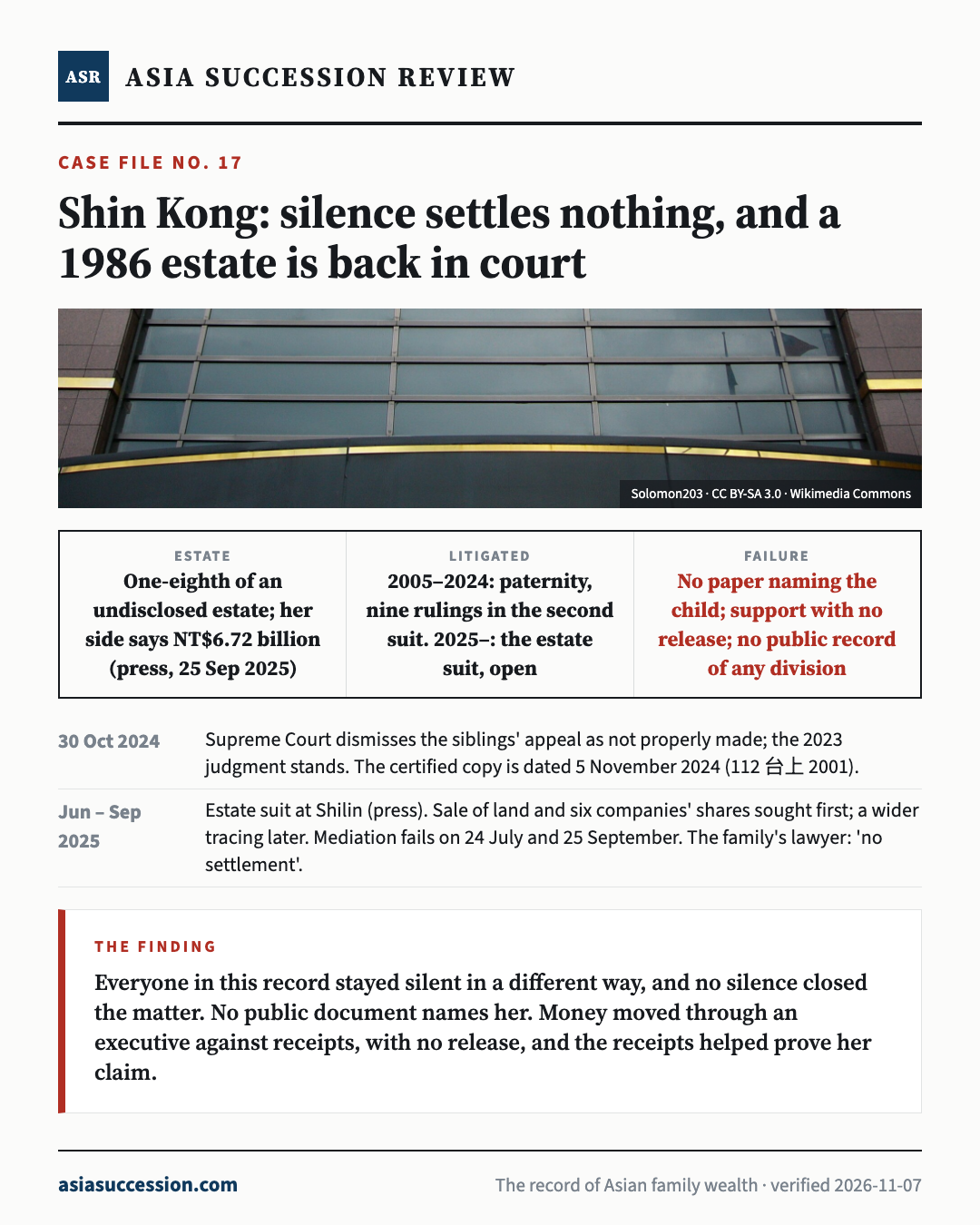
The case in one card — press and hold to save, or forward it as it is.
If your family's arrangements were never written down
Many Asian families carry an arrangement nobody has put on paper: a relative supported quietly, a promise the founder made, a payment made through a trusted executive. The questions worth settling while everyone is alive are short. Has every person the founder means to provide for been named in a dated document? If an estate has been divided, where is the signed record, and who holds it? Is anyone being paid with no written terms? If a court asked for a test, who would decide the answer? Asking is stewardship. Clarity is kind; ambiguity is what ends up in court.
Is 陳子婷 legally the daughter of 吳火獅?
Yes, since 30 October 2024. That day Taiwan's Supreme Court dismissed the appeal by his six children (112 台上 2001), leaving in place the High Court judgment of 10 May 2023 that he must recognise her under Civil Code art 1067. Recognition reaches back to birth (art 1069). The final ruling turned on whether the appeal was properly made; the reasoning is in the 2023 judgment.
Why did the 吳火獅 paternity case take almost 20 years?
There were two suits. The first, filed in January 2005, failed because she was presumed her mother's husband's child while Wu lived and could not prove he raised her; it ended on 21 May 2007. The law allowing a suit against a dead father's heirs came two days later. The second, filed on 1 June 2012, produced nine rulings and three Supreme Court remands before ending on 30 October 2024.
Why did refusing a DNA test count against 吳東亮, 吳東進 and their siblings?
A Taiwanese court cannot force a test, but may weigh an unjustified refusal with other evidence. The lab needed a sister, so sessions were set for 吳如月 and 吳如英 on 2 April 2014 and 1 June 2015; only Chen attended, and the six said they had no wish to test. With her mother's evidence, the money records and a recording, the High Court found the blood tie proved.
Can a child recognised after the father's death inherit in Taiwan?
Yes, within limits. Recognition reaches back to birth, but rights already acquired stay (art 1069). The Supreme Court held in 2014 that same-rank heirs keep what they have taken, while undivided or later-found property stays open (103 台上 618), and in 2021 that the protection needs good-faith reliance (110 台上 1880). Lower courts split on the facts: Chiayi in 2023 against the heirs, Tainan in 2026 for them.
Is 陳子婷's estate claim too late? What is the 15-year limit?
Undecided. The claim to recover an inheritance lapses ten years after succession opens (art 1146), here 18 October 1996, as Shilin said in 2015. But Interpretation 771 of 14 December 2018 held that the heir keeps her rights and may use property claims, subject to the 15-year limit (art 125). Whether that clock ran from 1986 or from 2024 has not been ruled on in this case.
How much is she claiming, and is it NT$10 billion?
No court has said. 'NT$10 billion' is a press figure. Her lawyer says her share is one-eighth and put it at NT$6.72 billion on 25 September 2025, which implies about NT$53.8 billion in all on our arithmetic. Mirror Media reported an estate tax bill of just over NT$3 million, implying a few hundred million. She is reported to be starting with about NT$16 million.
Would she have inherited under Singapore law?
Not without a will. Singapore's intestacy shares go to the lawful spouse and to legitimate or adopted children, and AAG v Estate of AAH [2009] SGCA 56 shut out maintenance from the father's estate too, though the Court of Appeal urged reform. Taiwan's art 1067 is more generous to her. A Singapore will or trust naming her would have changed that: non-Muslim estates have no forced shares.
Would a Singapore trust have kept the Shin Kong estate out of court?
Not by itself. A Taiwanese national's succession and Taiwanese assets follow Taiwanese law (涉外民事法律適用法 art 58), forced shares included. Trustees Act 1967 s90 has conditions and, on our reading, does not bind a Taipei court. What could have changed the outcome is paper: a document naming her, a settlement with a release, and a signed record of what was divided.
A question of your own that these don't answer — put it to the desk.
- 1Supreme Court of Taiwan, 112 台上 2001 (ruling of 30 October 2024; certified copy 5 November 2024): the six siblings' appeal dismissed as not properly made; the 2023 reasoning summarised (Judicial Yuan database, read in full 7 November 2026)
- 2Taiwan High Court, 111 家上更三 17 (10 May 2023): Wu must recognise her; undisputed facts, her mother's evidence, bank records, receipts, the 14 July 2011 recording, the refused tests
- 3Supreme Court, 110 台上 829 (7 September 2022): 2020 judgment set aside; the payments and recording needed proper weighing
- 4Taiwan High Court, 108 家上更二 4 (17 June 2020): ruled against her; dates and history of the first suit
- 5Supreme Court, 108 台上 125 (18 June 2019): 2018 judgment set aside; the first suit never decided the blood tie; arts 1065 and 1067 are separate claims
- 6Taiwan High Court, 106 家上更(一) 4 (2 October 2018): ruled against her; first suit final on 21 May 2007
- 7Supreme Court, 106 台上 733 (21 April 2017): 2015 judgment set aside on the siblings' appeal
- 8Shilin District Court, 104 家訴 27 (8 October 2015): suit for the alleged 23 November 2004 estate agreement dismissed; the family's denial; ten-year limit in art 1146(2)
- 9Taiwan High Court, 103 家上 214 (18 August 2015): first-instance judgment upheld; widow added; tests of 2 April 2014 and 1 June 2015
- 10Shilin District Court, 101 親 70 (30 June 2014): first-instance judgment; suit filed 1 June 2012; first suit filed January 2005
- 11Supreme Court, 103 台上 618 (2 April 2014): art 1069 proviso; same-rank heirs keep what they have inherited; undivided or later-found property stays open to a posthumously recognised child
- 12Supreme Court, 110 台上 1880 (28 July 2021): the art 1069 proviso protects heirs who relied in good faith
- 13Supreme Court, 108 台上 1544 (27 February 2020): a posthumously recognised daughter out of time under art 1146 may still use art 767 against the father's sister (Interpretation 771 applied)
- 14Chiayi District Court, 112 家繼訴 14 (12 June 2023): heirs who had hired counsel in the paternity suit before registering a division not protected
- 15Taiwan High Court, Tainan Branch, 114 家上 101 (22 July 2026): recognition granted, but property divided before it took effect stays with the heirs; open to appeal when read on 7 November 2026
- 16Judicial Yuan Interpretation 771 (14 December 2018): the recovery claim and property claims stand side by side; art 125 applies to art 767 claims (Ministry of Justice)
- 17Civil Code art 1067: suit for recognition, including against the father's heirs (Laws & Regulations Database, read 7 November 2026; arts 125, 128, 767, 1065, 1069, 1138, 1141, 1144, 1146, 1151, 1164, 1173, 1187 and 1223 read the same day)
- 18Civil Code art 1069: recognition reaches back to birth; rights already acquired by third parties stay
- 19Civil Code art 1146: recovery of an inheritance, two years from knowledge, ten from the opening of succession
- 20涉外民事法律適用法 art 58: succession follows the deceased's nationality; Taiwanese heirs and assets in Taiwan
- 21AAG v Estate of AAH, deceased [2009] SGCA 56 (19 November 2009): no maintenance claim for a child born outside marriage; reform urged at [41] (eLitigation, read 7 November 2026)
- 22Inheritance (Family Provision) Act 1966, s2 (Singapore Statutes Online, as at 5 November 2026; ss3 and 4 as at 6 November 2026)
- 23Intestate Succession Act 1967, s7: rules for distribution (Singapore Statutes Online, as at 6 November 2026)
- 24Trustees Act 1967, s90: validity of certain trusts, conditions in s90(3), reserved powers in s90(5) (Singapore Statutes Online, read 7 November 2026)
- 25Financial Supervisory Commission, 31 March 2025: Taishin Financial to merge Shin Kong Financial and take the name 台新新光金融控股
- 26TS Financial Holding, investor presentation, 29 August 2025 (TWSE filing): merger date 24 July 2025; total assets above NT$8 trillion
- 27Press, not a court record. Mirror Media, 20 July 2025: the suit, its two phases, the defences unnamed sources expect, the tax figure. It says NT$300,000 a month where the judgments say every three months, and dates the Supreme Court result to November 2024
- 28Press, not a court record. Liberty Times, 25 September 2025: NT$6.72 billion, mediation failed, the family's lawyer
- 29Press, not a court record. Next Apple, 25 September 2025: her lawyer on one-eighth, about NT$16 million and a fee of about NT$160,000 (Liberty Times reports NT$1.6 million). The reported base of 1/8 of 1/10 of NT$13 billion multiplies to about NT$162 million, not NT$16 million
- 30Press. Commercial Times, 12 June 2026: 吳東亮 as chairman at TS Financial's first annual meeting after the merger