Own your trustee and control waits for probate. Ask Henderson Land
李兆基 (Lee Shau-kee) put Henderson Land's controlling block under trustees by 1999 at the latest. When he died on 17 March 2025, aged 97, the 72.50 per cent stake did not move. What did move were the shares of the three trustee companies, which he owned himself: they went through his estate and reached his two sons fifteen months later. The filings that name the sons are silent on his three daughters, and Hong Kong's disclosure rules explain why.
Read this in: EN · 简体 · 繁體 · ไทย · ID
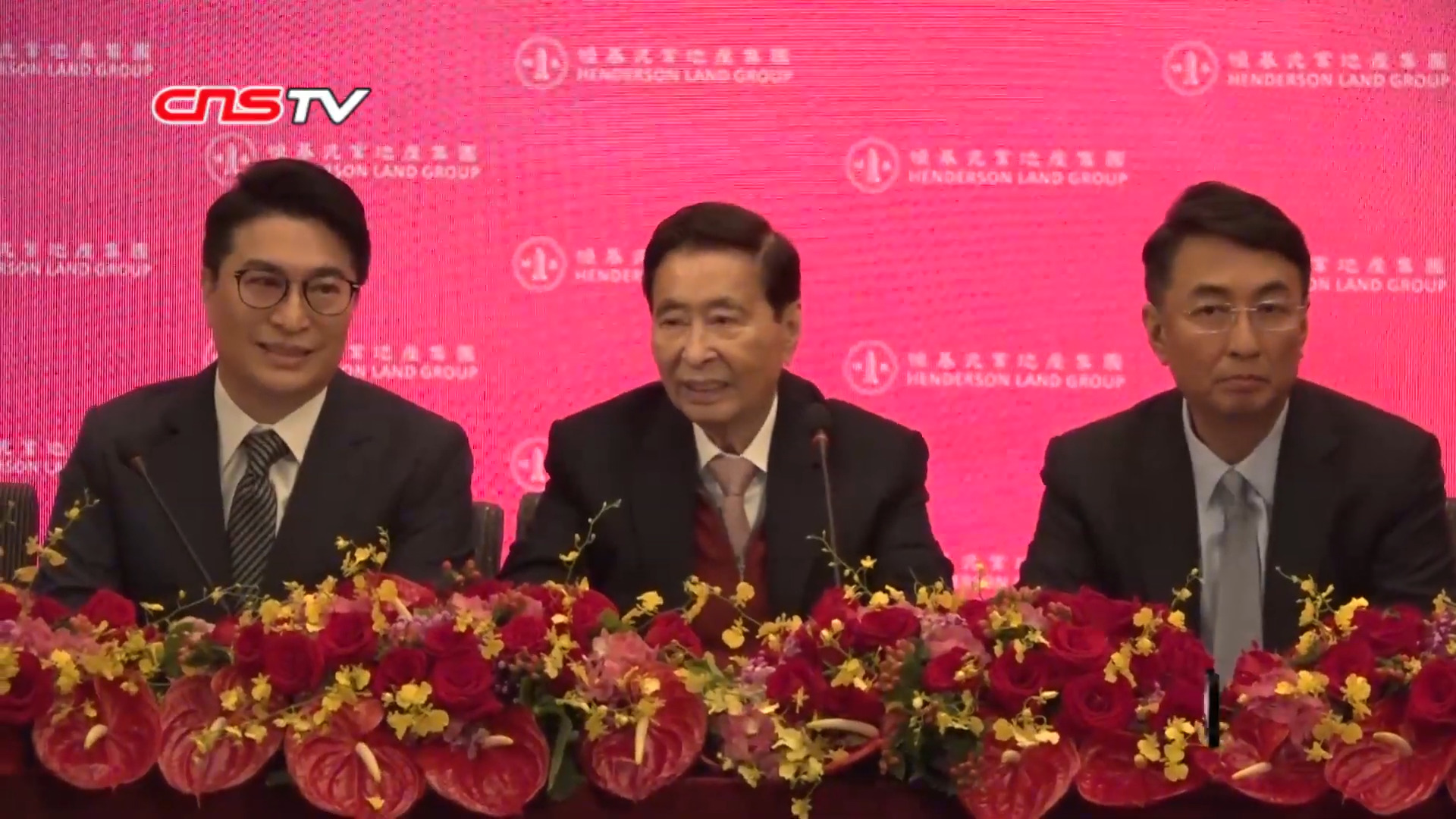
A founder hands Henderson Land's controlling block to trustees by 1999, decades before it matters
Lee Shau-kee (李兆基) founded Henderson Land in 1976 and listed it in Hong Kong in 1981; at the end of 2024 the market valued it at HK$114bn, its annual report says. Long before he stepped back, the controlling block had left his own name. At 30 June 1999 the shares sat under Hopkins (Cayman), trustee of a unit trust whose units were held by Rimmer (Cayman), trustee of a discretionary trust. He owned both trustee companies outright. By 2010 there were two discretionary trusts, the second under Riddick (Cayman), and the company recorded his two sons as beneficiaries.
He dies at 97 in March 2025, and the sons file the same 3,509,782,778 shares before and after
On 28 May 2019, citing his advanced age, he handed the chair to the sons, 李家傑 (Peter Lee Ka-kit) and 李家誠 (Martin Lee Ka-shing), as joint chairmen. He died on 17 March 2025, aged 97. The block did not move. At the end of 2023 he was interested in 3,525,331,445 shares, 72.82 per cent: 15,548,667 in his own name and 3,509,782,778 through the trusts. Four days after his death each son filed the same 3,509,782,778 shares, 72.50 per cent, before and after. The board said the death would not affect operations.
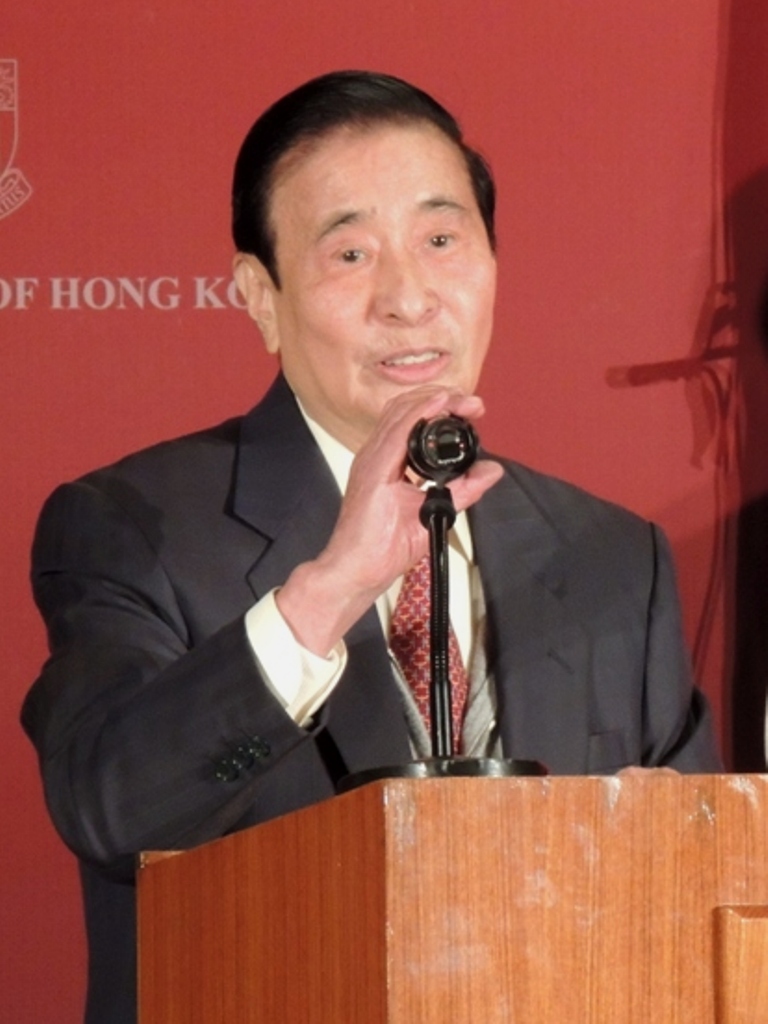

The trustee companies he owned himself go through his estate and reach his sons 15 months later
What moved was smaller and slower. The trustee companies were his own property, so their shares fell into his estate; the March 2025 filings said each son 'will inherit certain shares' in them. The transfer was recorded on 29 June 2026, fifteen months later: half of each trustee company to each son. A filing for the same day by his son-in-law, 李寧 (Li Ning), a director of Hong Kong Ferry, shows that 799,280 of its shares had been transmitted to the executors of the founder's Hong Kong estate, and that his wife, the eldest daughter 李佩雯 (Margaret Lee Pui-man), is one of them.
The daughters are missing from the filings because the law never lists them, not because the trust leaves them out
None of the three daughters appears in the March 2025 filings. The disclosure rules explain why. Hong Kong's Securities and Futures Ordinance makes a director count shares held in a discretionary trust of which he is a beneficiary (s345(4)(a)); for anyone else, a discretionary interest is disregarded (s323(1)(a)(iii)). The sons sit on the board; the daughters do not. Margaret, who joined the company in 1984 and is a senior general manager, surfaced through her husband: on 29 April 2026 he filed that she is a discretionary beneficiary of both trusts, the Henchild Trust and the Henley Trust. On the two other daughters, the record read is silent.
The trust did its job. The 72.50 per cent block sat with the same trustees before and after 17 March 2025, needed no grant of probate and, as at 24 October 2026, no court. What it left open sat around it. The trustee companies were his personal property, so the shares that decide who runs the trustees went through his estate, under a will whose terms are not public, and reached his sons fifteen months later, half each, with no tie-break in any filing. The trusts are discretionary: no child has a published entitlement. A daughter missing from a filing is not missing from the trust; a son named in one is not thereby entitled.
Keep what Henderson did, the block in trust decades early; add what it left out: trustee companies no one inherits, a written tie-break between two equal heirs, and a statement to every child of where they stand.
Hong Kong charges no estate duty since 2006, so a Singapore structure would change the instrument, not the tax
Start with what Singapore would not change. Hong Kong charges no estate duty on deaths on or after 11 February 2006 (Inland Revenue Department); Singapore removed it for deaths on or after 15 February 2008 (IRAS). Hong Kong's Trustee Ordinance lets a settlor reserve investment powers (s41X) and shields a Hong Kong-law trust from foreign inheritance rules (s41Y); Singapore's Trustees Act 1967 does the same in s90(5) and s90(2)–(3). Henderson is listed in Hong Kong, so its filings would read the same. The honest comparison is narrow: the counterfactual lies in the instrument, not the flag. Statutes read on SSO and eLegislation on 24 October 2026.
Trustee companies held inside a trust never die, so a founder's death needs no executor at the top
First, take the trustee companies out of anyone's estate. Lee owned Rimmer, Riddick and Hopkins himself, so on his death their shares were estate assets, the kind that wait for a grant, while assets held by a trust do not. A trustee company whose own shares sit in a separate trust, or a trust company licensed under Singapore's Trust Companies Act 2005 (s3), does not die; a change at the top becomes a board resolution, not an executor's transfer. The Trustees Act shield needs a trust expressed to be governed by Singapore law, Singapore-resident trustees, and a settlor who is neither a citizen nor domiciled there (s90(3)).
Two brothers who each own half get a written casting vote before they ever need one
Second, write the tie-break before anyone needs it. Since 29 June 2026 each brother has owned half of each trustee company. Half and half works while two people agree. A deed of family arrangement, or the trustee companies' own constitutions, can name an independent director or protector with a casting vote on a stated list of matters, and a procedure for disagreement. Nothing in the record suggests the brothers disagree. The point of a tie-break is that it is written while no one does.
Every adult child, son or daughter, gets a letter saying where they stand in the family trust
Third, tell every child where they stand. In a discretionary trust the founder's intentions live in a letter of wishes to the trustees. A short written statement to each adult beneficiary, son or daughter, that they are in the class and how the trustees mean to use their discretion replaces inference from filings. The statutes are no substitute: Hong Kong lets an adult child claim only if the deceased was maintaining them (Cap 481 s3(1)(vi)) and reaches gifts only within six years of death (s12); Singapore's Act applies only to a deceased domiciled there and covers an adult daughter only if unmarried or disabled (s3(1)).
李家傑 and 李家誠, the joint chairmen — the trustee companies' boards from the day of the deed, instead of shares that reached them by inheritance on 29 June 2026, plus a written tie-break for the day they disagree
李佩雯 (Margaret Lee), the eldest daughter — the trustees' written statement of her place in both trusts, instead of a position visible only through her husband's filing in another listed company
The two other daughters — the same written statement, instead of a filing record that by law says nothing either way
Henderson Land's other shareholders — what they already had: a 72.50 per cent block whose holder did not change when the founder died
A counterfactual, not advice: real structures need licensed hands and your family's facts.
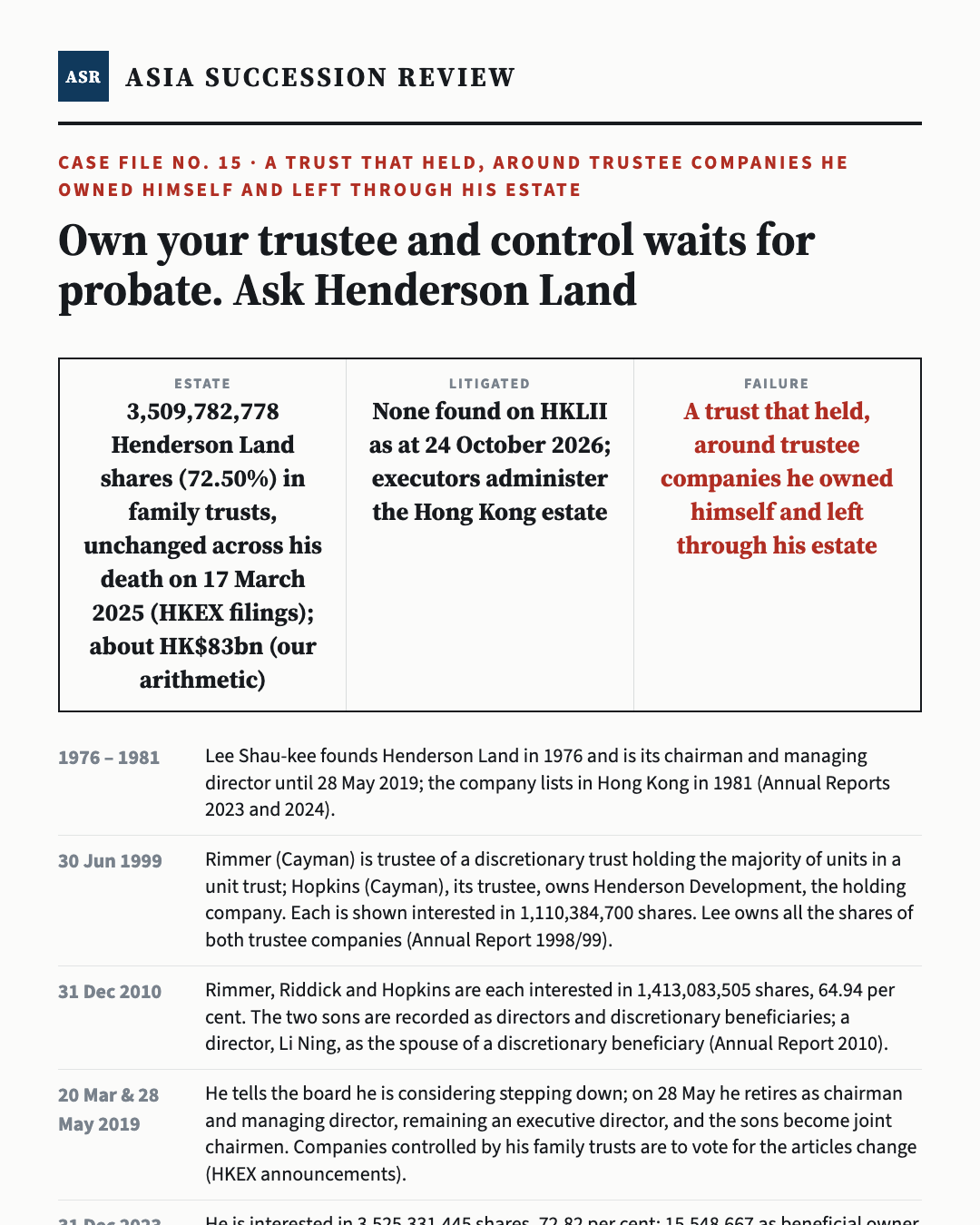
The case in one card — press and hold to save, or forward it as it is.
If your family's shares sit in a trust you have never read
Many Hong Kong and Southeast Asian founders built what this one built: listed shares under trustees, decades early. The questions worth settling while everyone is alive are about the parts around the trust. Who owns the trustee company? If it is the founder, it will pass through his estate, by his will. If two heirs end up with half each, who breaks a tie? Are you a beneficiary, and how would you know? If you are not a director, no filing will tell you. Has anyone put each child's position in writing? Asking is stewardship. Clarity now is what lets the next generation plan its own decade.
Who controls Henderson Land after Lee Shau-kee's death?
The same trusts as before. 3,509,782,778 shares, 72.50 per cent, are held under Hopkins (Cayman) as trustee of the Henfull Unit Trust, whose units are held by Rimmer and Riddick (Cayman) as trustees of two discretionary trusts. Since 29 June 2026 each son, 李家傑 (Peter Lee) and 李家誠 (Martin Lee), owns half of each trustee company 'by inheritance', their filings say. Both have been joint chairmen since 28 May 2019.
Did Lee Shau-kee's sons inherit his Henderson Land shares?
Not the controlling block. It stayed with the trustees, and its count did not change: 3,509,782,778 shares before and after 17 March 2025. What the sons inherited were the shares of the three trustee companies, which their father owned outright; the transfer was recorded on 29 June 2026. His 15,548,667 shares held in his own name formed part of his estate; no Henderson Land filing shows who holds them now.
Are Lee Shau-kee's daughters beneficiaries of the family trust?
The eldest is. On 29 April 2026 her husband, 李寧 (Li Ning), a director of Hong Kong Ferry, filed that his spouse, 李佩雯 (Margaret Lee), is a discretionary beneficiary of both the Henchild Trust and the Henley Trust. Henderson's 2010 annual report had already recorded him as the spouse of a discretionary beneficiary. On the two other daughters, the public record read says nothing either way.
Why were Lee Shau-kee's daughters not named in the March 2025 filings?
Because Hong Kong's disclosure rules would not name them. A director must count shares held in a discretionary trust of which he is a beneficiary (Securities and Futures Ordinance s345(4)(a)); for anyone else, a discretionary interest is disregarded (s323(1)(a)(iii)). The sons are directors of Henderson Land; the daughters are not. Absence from a filing is not evidence of exclusion from a trust.
Did Lee Shau-kee's estate go through probate?
Part of it. The trust block needed no grant. The trustee companies' shares and his personal holdings formed his Hong Kong estate, administered by executors; a 30 June 2026 filing names his eldest daughter as one of them. Executors are appointed by will, and the will's terms are not public. An HKLII search on 24 October 2026 found no judgment concerning the estate.
Did Lee Shau-kee's estate pay estate duty in Hong Kong?
No estate duty is charged on deaths in Hong Kong on or after 11 February 2006, when the Revenue (Abolition of Estate Duty) Ordinance 2005 took effect, the Inland Revenue Department says. He died on 17 March 2025. Singapore removed estate duty for deaths on or after 15 February 2008 (IRAS), so a Singapore structure would have saved no tax.
Could a daughter claim against Lee Shau-kee's estate in Hong Kong?
Only narrowly. The Inheritance (Provision for Family and Dependants) Ordinance (Cap 481) lets an adult child apply only if the deceased was maintaining them immediately before death (s3(1)(vi)), within six months of the grant unless the court allows (s6), and reaches lifetime gifts only if made within six years of death to defeat a claim (s12). Trusts in place by 1999 lie far outside that window.
Would a Singapore trust have changed the Henderson succession?
Very little. Hong Kong already has no estate duty, lets a settlor reserve investment powers (Trustee Ordinance s41X) and shields Hong Kong-law trusts from foreign inheritance rules (s41Y), as Singapore's Trustees Act 1967 s90 does. What might have changed the outcome is the instrument: trustee companies no one inherits, a written tie-break between the brothers, and a statement to each child of where they stand.
A question of your own that these don't answer — put it to the desk.
- 1HKEX disclosure of interests, Form 3A DA20250321E00294 (filed 21 March 2025): Lee Shau Kee ceases to be a director on his death on 17 March 2025; 3,525,331,445 shares (72.82%), 15,548,667 as beneficial owner; his two sons 'will inherit certain shares' in Rimmer, Riddick and Hopkins (Cayman)
- 2HKEX disclosure of interests, Form 3A DA20250321E00308 (filed 21 March 2025): Lee Ka Kit, 3,509,782,778 shares (72.50%) before and after; 'I will inherit certain shares in TDT1, TDT2 & TUT1'; remains a discretionary beneficiary
- 3HKEX disclosure of interests, Form 3A DA20250321E00322 (filed 21 March 2025): Lee Ka Shing, the same 3,509,782,778 shares (72.50%) and the same statement
- 4HKEX disclosure of interests, Form 3A DA20260630E00284 (filed 30 June 2026): Lee Ka Kit, 'by inheritance, 50% of shares in each of TDT1, TDT2 & TUT1'; relevant event 29 June 2026; 3,509,782,778 shares (72.50%) of 4,841,387,003 issued
- 5HKEX disclosure of interests, Form 3A DA20260630E00331 (filed 30 June 2026): Lee Ka Shing, the same 50% of each trustee company by inheritance
- 6HKEX disclosure of interests, Hong Kong Ferry (00050), Form 3A DA20260429E00366 (filed 29 April 2026): Li Ning; spouse Lee Pui Man, Margaret 'is one of the discretionary beneficiaries' of the Henchild Trust and the Henley Trust; Henfull Unit Trust
- 7HKEX disclosure of interests, Hong Kong Ferry (00050), Form 3A DA20260630E00378 (filed 30 June 2026): Li Ning; spouse 'one of the executors of the Hong Kong estate of Dr Lee Shau Kee'; 799,280 shares transmitted to the executors on 29 June 2026
- 8Henderson Land announcement, 18 March 2025: passing of the founder and executive director on 17 March 2025; no impact on the group's operations
- 9Henderson Land announcement, 20 March 2019: chairman considering stepping down; joint-chairmanship amendments to the articles
- 10Henderson Land announcement, 27 May 2019: retirement of the chairman and managing director at the 28 May 2019 AGM; Lee Ka Kit and Lee Ka Shing joint chairmen; family-trust companies to vote for the articles change
- 11Henderson Land Annual Report 1998/99: substantial shareholders at 30 June 1999; Rimmer (Cayman) trustee of a discretionary trust, Hopkins (Cayman) trustee of the unit trust; Lee Shau Kee owns both trustee companies
- 12Henderson Land Annual Report 2010: Rimmer, Riddick and Hopkins each interested in 1,413,083,505 shares (64.94%) at 31 December 2010; sons as discretionary beneficiaries; Li Ning as spouse of a discretionary beneficiary
- 13Henderson Land Annual Report 2023 (dated 21 March 2024): Lee Shau Kee interested in 3,525,331,445 shares (72.82%) at 31 December 2023; biographies of Lee Pui Man, Margaret and Li Ning
- 14Henderson Land Annual Report 2024 (dated 20 March 2025): founded 1976, listed 1981; market capitalisation HK$114bn at 31 December 2024
- 15Henderson Land Interim Report 2025: the trustee companies 'beneficially owned by the late Dr Lee Shau Kee'; each son 'will inherit certain shares'
- 16Henderson Land Annual Report 2025 (dated 23 March 2026): trustees interested in 3,509,782,778 shares (72.50%) at 31 December 2025
- 17Henderson Land Interim Report 2026: at 30 June 2026, 50% of each of Rimmer, Riddick and Hopkins owned by each of Lee Ka Kit and Lee Ka Shing
- 18Securities and Futures Ordinance (Cap 571), s323: discretionary interests disregarded for substantial-shareholder notification (eLegislation, read 24 October 2026)
- 19Securities and Futures Ordinance (Cap 571), s345: a beneficiary of a trust taken to be interested, for directors' notification
- 20Securities and Futures Ordinance (Cap 571), s346: interests disregarded for directors (no carve-out for discretionary interests)
- 21Inheritance (Provision for Family and Dependants) Ordinance (Cap 481), ss3, 6, 12 (eLegislation, version date 21 April 2022)
- 22Trustee Ordinance (Cap 29), s41X: reserve power of settlor (commencement 1 December 2013)
- 23Trustee Ordinance (Cap 29), s41Y: transfer of movable property not affected by foreign law of inheritance
- 24Inland Revenue Department (Hong Kong): Revenue (Abolition of Estate Duty) Ordinance 2005 in effect from 11 February 2006
- 25Trustees Act 1967, s90: validity of certain trusts (Singapore Statutes Online, as at 24 October 2026)
- 26Inheritance (Family Provision) Act 1966, s3: dependants of a deceased domiciled in Singapore (Singapore Statutes Online, as at 24 October 2026)
- 27Trust Companies Act 2005, s3: trust business only by a licensed trust company (Singapore Statutes Online, as at 24 October 2026)
- 28IRAS: estate duty removed for deaths on and after 15 February 2008
- 29HKLII simple search for 'Lee Shau Kee', 24 October 2026: three results, none concerning his estate or the family trusts
- 30Associated Press, 17 March 2025: Lee Shau Kee dies at 97; survived by two sons and three daughters (press)