Sun Hung Kai: the trust held the company; it could not hold the brothers
The Kwok family's controlling block in Hong Kong's Sun Hung Kai Properties has sat inside discretionary trusts since before the founder died in 1990. In 2008 the board removed the eldest son as chairman; in September 2010 the trustee wrote him out of the trusts entirely; in January 2014 the family wrote his branch back in. Not one controlling share ever passed through an estate — and not one document ever said who decides whether a brother is fit to run the company.
Read this in: EN · 简体 · 繁體 · ไทย · ID
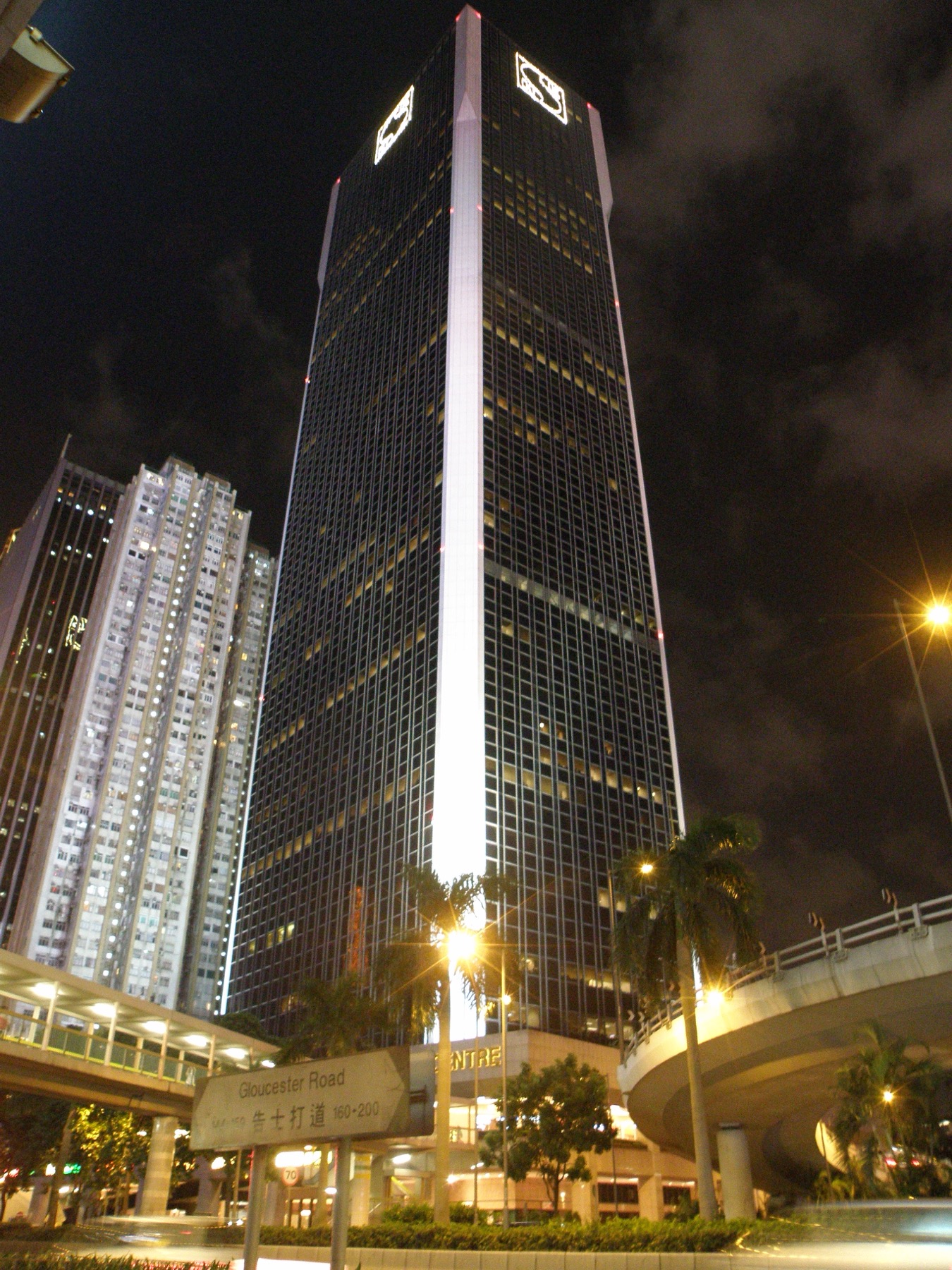
Kwok Tak-seng lists his property group six weeks after founding it, with the family block already held by a trustee
Kwok Tak-seng 郭得勝 incorporated Sun Hung Kai Properties 新鴻基地產 on 14 July 1972 and listed it in Hong Kong six weeks later, on 23 August. He died in October 1990, and by then the arrangement that still governs the company was already in place: the family's controlling block was not owned by any individual but held through discretionary trusts, with a professional trustee registered as the party interested in the shares — HSBC International Trustee Limited in the filings of that era, HSBC Trustee (C.I.) Limited later.
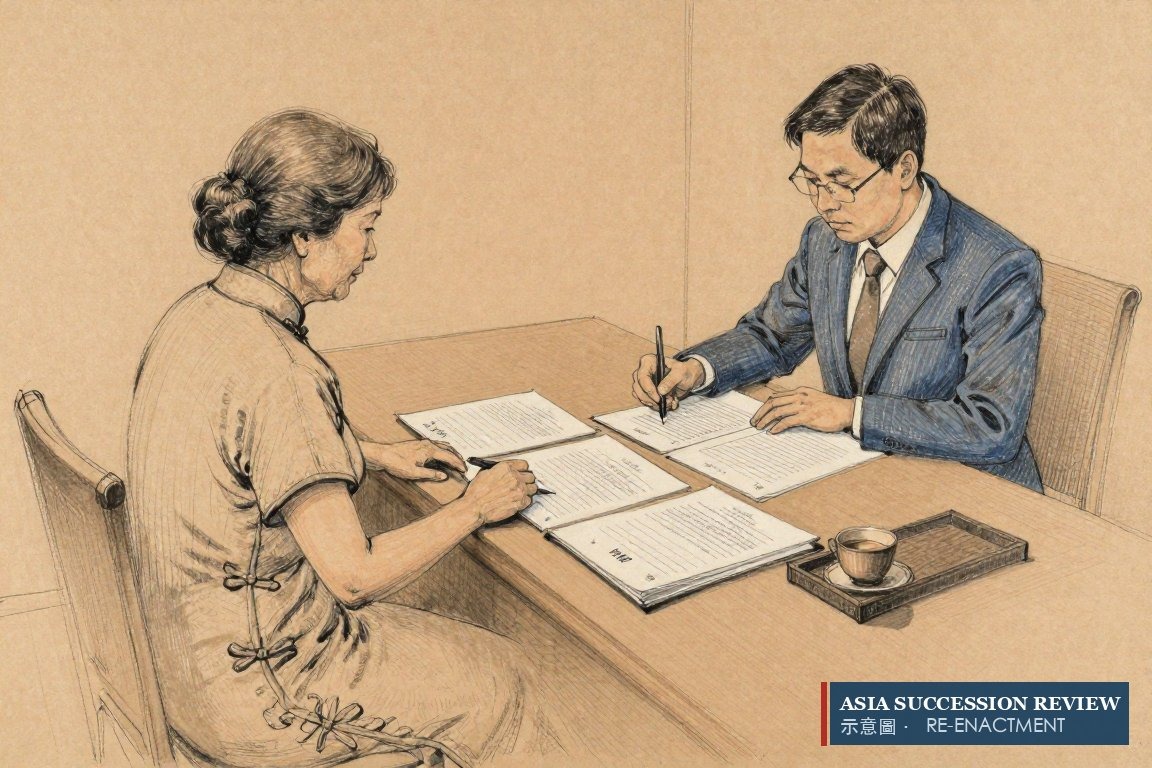
The founder's widow settles the trusts and her three sons appear inside 42.49 per cent of the company
In every disclosure since, the founder's widow, Kwong Siu-hing 鄺肖卿, appears as the founder of those trusts, and her three sons — Walter Kwok Ping-sheung 郭炳湘, Thomas Kwok Ping-kwong 郭炳江 and Raymond Kwok Ping-luen 郭炳聯 — as beneficiaries. As at 30 June 2008 the trustee was disclosed as interested in 1,089,683,920 shares, 42.49% of the company. Walter, the eldest, was chairman and chief executive.
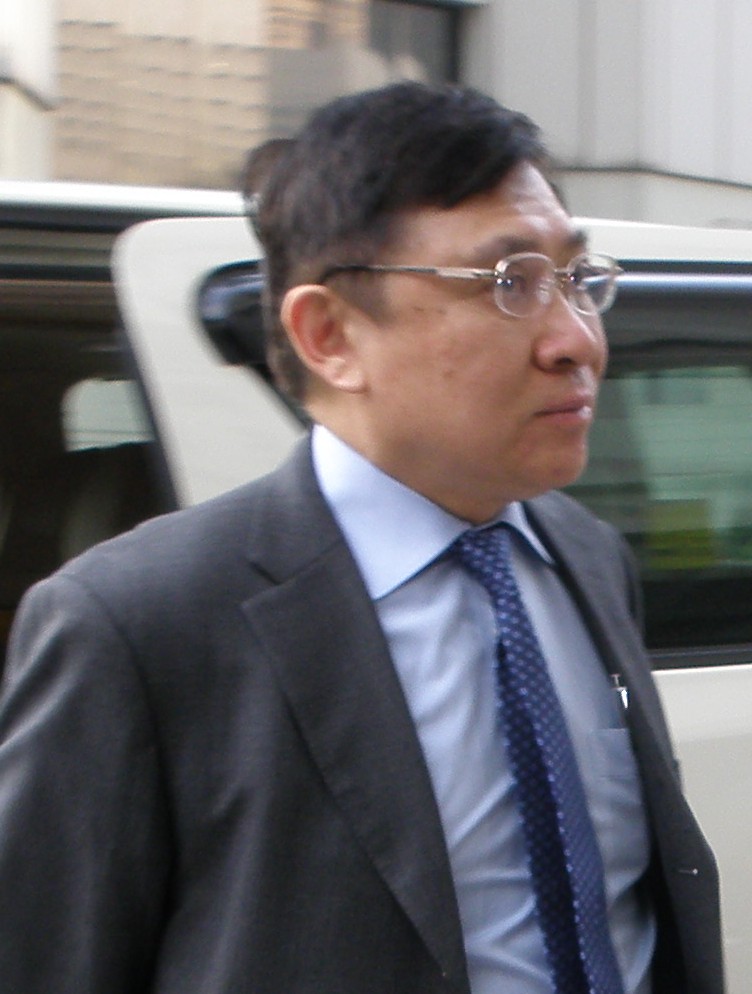

Gangsters take the eldest son in 1997 and release him a week later for a reported HK$600 million
In September 1997 he was kidnapped by Cheung Tze-keung 張子強, the criminal known as Big Spender, held about a week and released after a ransom reported at some HK$600 million — a sum the family never confirmed.

Walter registers a rival company in January 2008 and by 18 February the board sends its chairman on leave
On 23 January 2008 Walter Kwok registered a company of his own at the Hong Kong Companies Registry, with himself as sole director, to develop and trade property in Hong Kong and on the mainland; Forbes reported the filing three weeks later, after the family dispute became public. On the evening of 18 February the company announced that its chairman would take temporary leave for personal reasons, effective immediately, his duties assumed by his two younger brothers, both vice-chairmen and managing directors. Walter went to court.
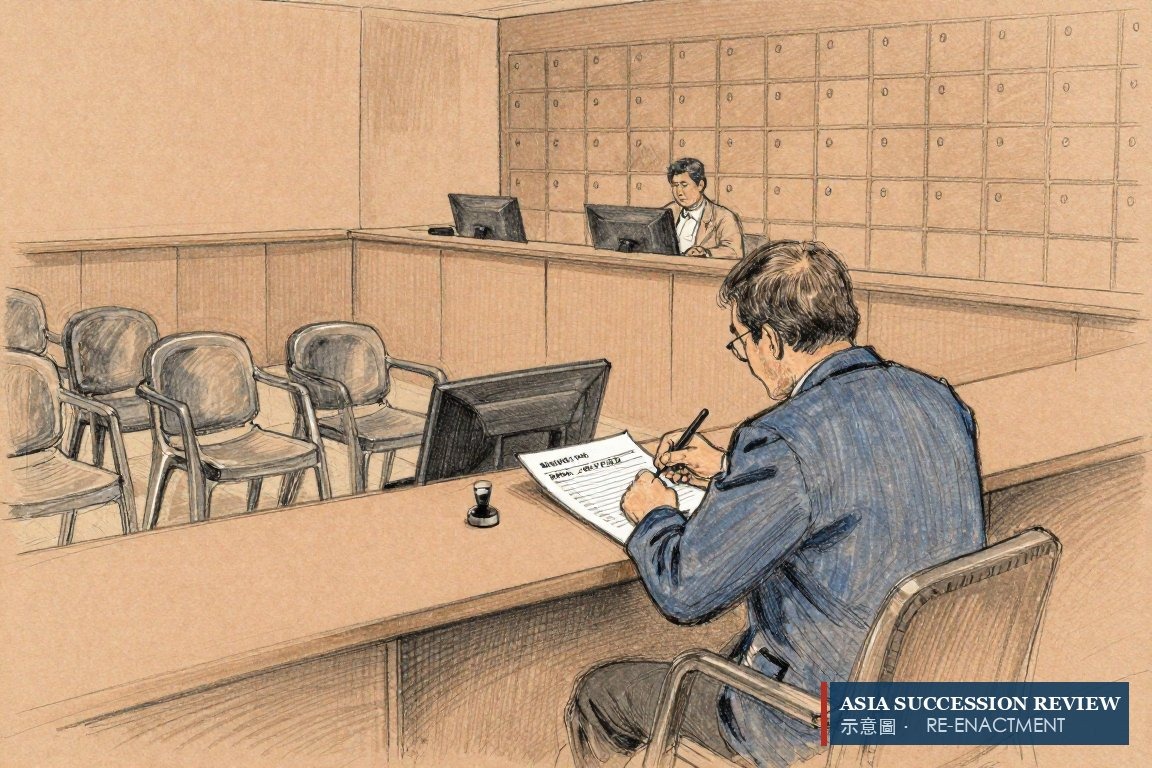
He sues 16 directors to stop his removal, saying his brothers arranged a bipolar diagnosis to justify it
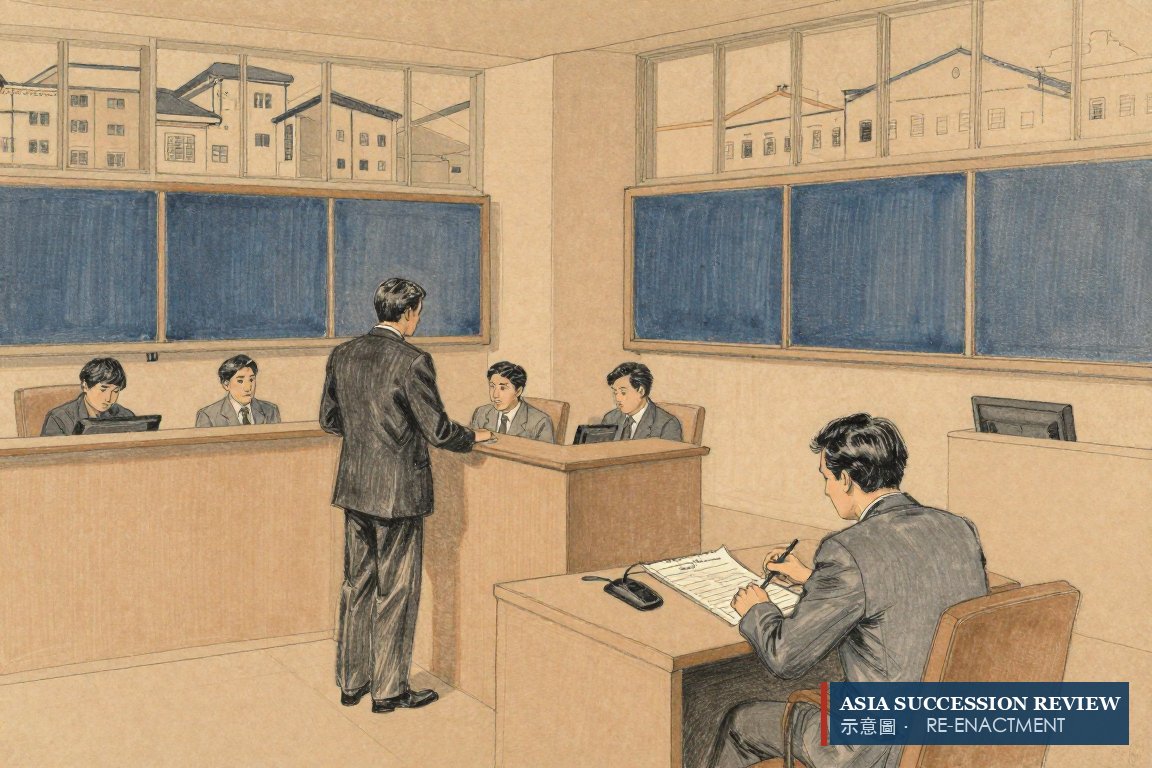
In HCA 857/2008 he sued the company and sixteen directors, his brothers among them, for an injunction restraining the board from even considering his removal — pleading an agreement that he would return after three months if two medical opinions found him fit, and alleging that his brothers had procured a psychiatric diagnosis of bipolar affective disorder to serve as the basis for removing him.
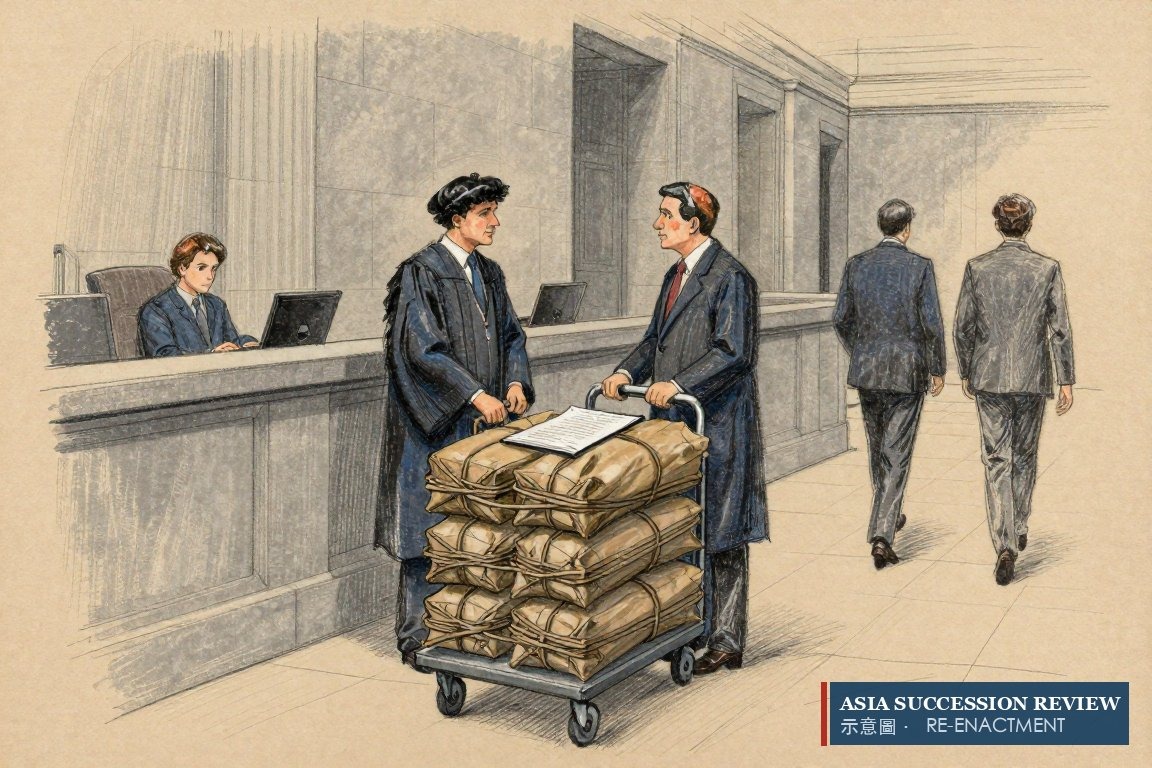
The judges refuse to stop the board, and in May 2008 his mother takes the chair instead
Kwan J refused: the choice of a listed company's chairman is internal management, and that is the board's. The Court of Appeal declined an injunction pending appeal, Rogers VP saying he had the gravest of doubts the court would ever grant one. On 27 May 2008 the board made the change. Kwong Siu-hing became chairman and a non-executive director; Walter was re-designated a non-executive director.
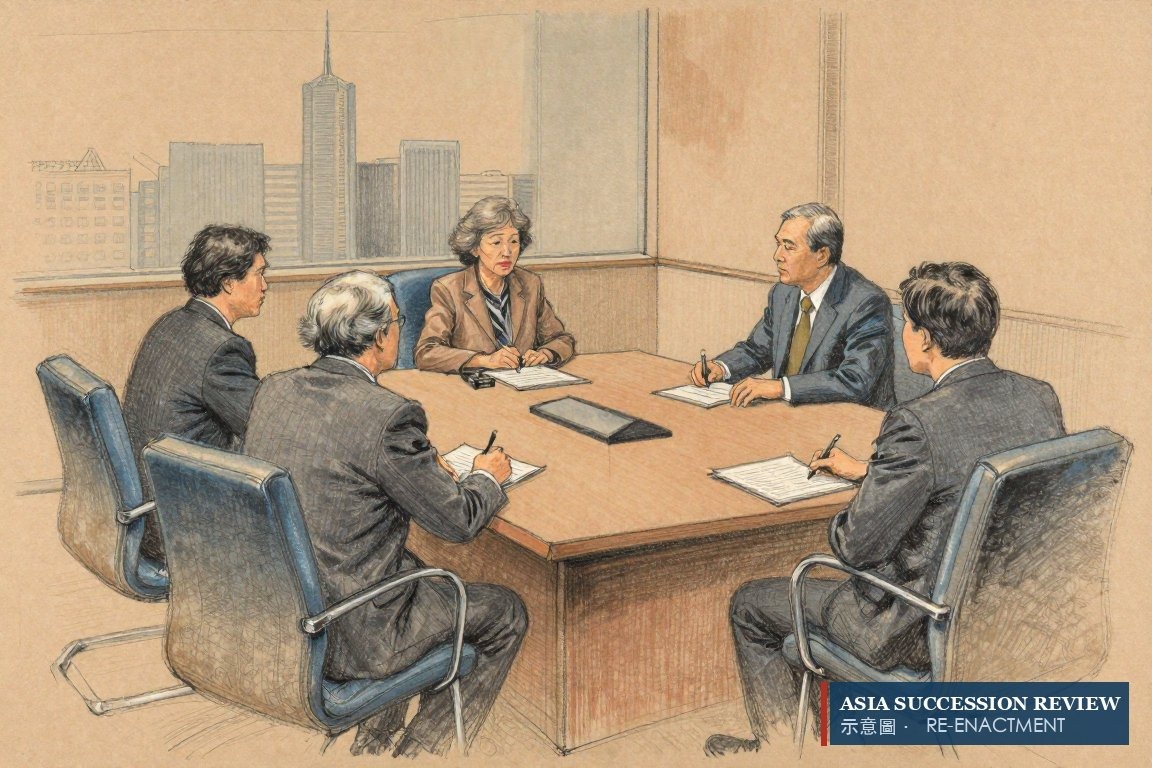
In 2010 the trustee reorganises the trusts and Walter holds no interest at all, with no court and no sale
Then the structure did something a board vote cannot. On 30 September 2010 the trustee informed the company that, consequent on a re-organisation of the trusts and with effect from 29 September, the deemed interests in the 1,081,739,328 SHKP shares it held had changed: Kwong Siu-hing continued to be interested in all of them; Thomas and Raymond were each interested in 371,286,430; and — the line stands in the company's 2010/11 annual report in the trustee's own words — Mr Kwok Ping Sheung Walter is not interested in any of the said shares. No court heard it. No share was sold.

Control never moves and his son's vehicle keeps its equal third, so the trusts remove the brother, not the branch
Control did not move: as at 30 June 2011 the trustee was still disclosed as interested in 42.09% of the company. What moved was one man's standing inside a deed. And note what did not move with him. Inside the trusts, three vehicles — Adolfa, Bertana and Cyric — held equal thirds of a common parcel, and the disclosures identify Adolfa with Walter's son Geoffrey Kwok Kai-chun 郭基俊, Bertana with Thomas's son Adam Kwok Kai-fai 郭基煇, and Cyric with Raymond and his sons. Adolfa stayed where it was. The trusts removed the brother; they did not remove the branch.
The two younger brothers take over as joint chairmen, and four months later the anti-graft agency arrests them both
The rest of the decade tested the company rather than the deed. Kwong Siu-hing retired at the annual general meeting on 8 December 2011 and Thomas and Raymond were appointed joint chairmen from the close of that meeting. On 29 March 2012 the Independent Commission Against Corruption arrested both; on 13 July 2012 both were charged, alongside the former Chief Secretary for Administration, Rafael Hui Si-yan 許仕仁.
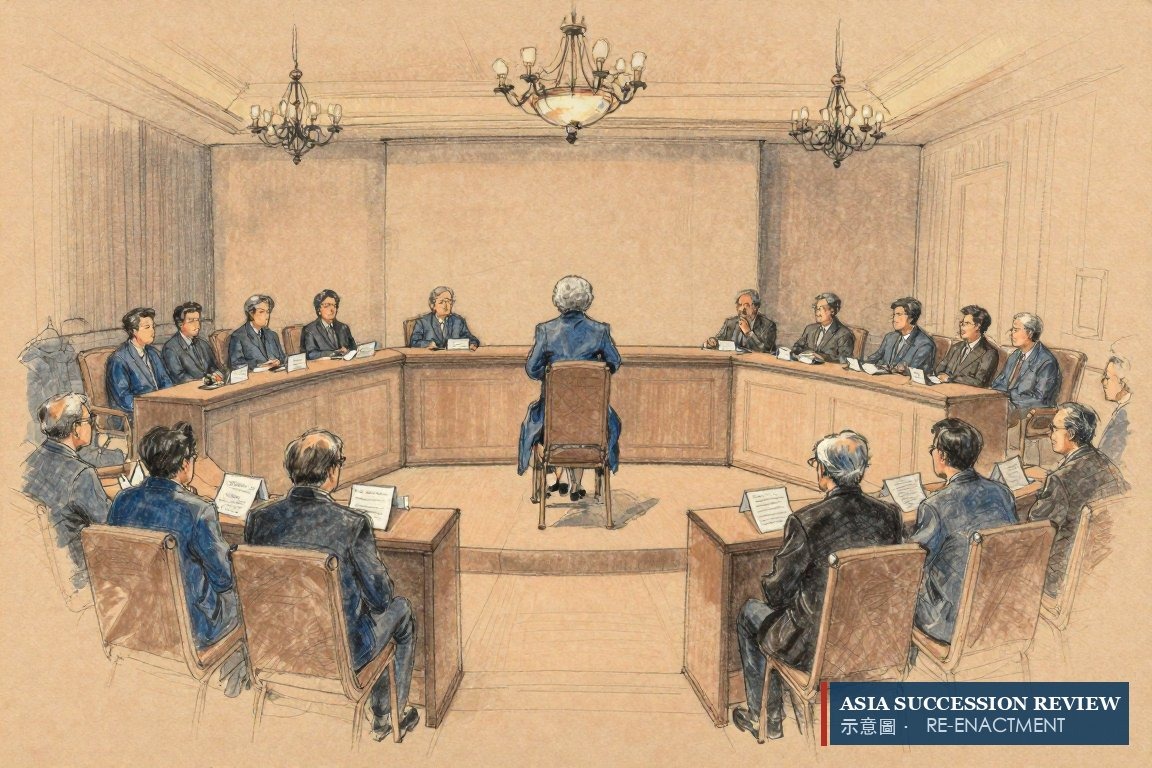
With the trial running, the family gives Walter his own trust of 7.16 per cent, matching each brother's branch
On 28 January 2014 — in the middle of that proceeding — the family announced an amicable agreement on the treatment of its interests, and the matriarch said Walter and his family had received the same entitlement to SHKP shares as his brothers and theirs. The filings show what that meant: as at 30 June 2014 Walter Kwok Ping-sheung appeared in his own right, deemed interested in 195,004,751 shares, 7.16% of the company, held through a separate discretionary trust of which he was founder and beneficiary, while his brothers' branches sat in parallel trusts of about the same size.
One brother goes to prison for five years and the other runs Sun Hung Kai alone ever since
On 19 December 2014 Thomas was convicted of conspiracy to commit misconduct in public office and sentenced to five years; Raymond was acquitted and has been chairman alone since. The Court of Final Appeal upheld the convictions on 14 June 2017.
Walter dies in 2018 and not one share passes through his estate, because both branches sit in trusts
Walter Kwok died in Hong Kong on 20 October 2018, aged 68, after a stroke. Not one SHKP share passed through his estate. By 30 June 2019 his branch's interests sat in two places, both trusts: Adolfa, inside the main family structure, disclosed at 10.62% and identified with Geoffrey; and a separate branch trust, then with Genesis Trust & Corporate Services Ltd. as trustee, at 7.29%, with his son Jonathan Kwok Kai-ho named as a person interested. As at 30 June 2025 HSBC Trustee (C.I.)
By 2025 the three grandsons hold almost equal fifths, but no deed ever said who decides a chairman is unfit
Limited is disclosed as interested in 1,336,019,743 shares, 46.10% of the voting shares; Adolfa, Bertana and Cyric each hold 12.16%; the trustee of Walter's branch trust is now named Highvern Cayman Limited at 8.75%. The three grandsons' aggregate deemed interests come out at 21.18%, 20.46% and 20.18%. Eighteen years after the feud began, the architecture reads exactly as it was designed to read: equal thirds, professionally held, nothing in an estate. What it never contained was a rule for deciding whether a brother was fit to run the company. That question went to a report commissioned by one side, a board vote, a writ, and the newspapers.

This is the rare file in which the structure worked. A lifetime settlement into discretionary trusts with a professional trustee meant the controlling block was never anyone's personal property, never froze on a death, never went to probate, and could be re-cut in 2010 and again in 2014 without a single share changing hands or a single court deciding who owned what. What the family never wrote was the second document: no charter naming the matters that need every branch's consent, no protocol saying in advance who assesses whether an executive is fit to serve and on whose medical evidence, no priced and pre-funded route by which a brother could leave, and no private forum. So the one question the deed did not answer — is the eldest son fit to run the company — was answered by whoever could assemble a report, a board majority and a press cycle first. A trust can decide who owns. Only a charter decides who governs.
Keep the trust that holds the shares — then sign the document it never had: a family charter fixing in advance who decides, on whose medical evidence, and at what price a brother leaves.
The founder settles the controlling stake while fully capable, so from that day the shares stop being anyone's property
Half of this answer needs no inventing, because the Kwok family already built it. The Singapore version is the same move: while entirely capable, the founder settles the controlling stakes into a living trust — a licensed Singapore trust company as trustee, the family exercising control through a private trust company it chairs, the deed fixing each branch's share in writing and a private letter of wishes explaining why. From that day the shares are not personal property.
Nothing freezes when someone dies, and a Singapore shield keeps foreign heirs from reaching into the family's shares
Nothing freezes on a death, nothing is valued by a court, nothing waits on a grant, and no branch can be reached by getting to a chair first. Singapore adds two things the Kwok record did not need but most regional families do: the Trustees Act section 90 shield against foreign forced-heirship claims, and a perpetuity period long enough that the deed outlives the grandchildren who will argue about it.
Every adult signs a family charter that prices an exit in advance, and insurance money stands ready to pay it
The other half is the part the record shows missing. In the same season, every adult member of every branch signs a family charter — one document, read by all of them, that says what the deed does not: which decisions require which consents (who chairs the operating company, who joins the board, what is sold), how a member who wants out is bought out and at what formula, and who pays for it. That last question is answered by insurance-created capital held for the purpose, so an exit is funded on the day it is agreed rather than negotiated against the company's cash.
Two independent specialists decide whether a man can serve, instructed by someone who is not his brother
And it says how fitness to serve is decided: two independent specialists, named or nominated by an agreed body, instructed by a party who is not a sibling, reporting to a protector or family council rather than to a faction — with each principal signing a Lasting Power of Attorney while unquestionably capable, so that the question of who acts for him is answered by him and not by proximity. Disputes go to confidential arbitration; the award binds like a judgment and nobody reads it.
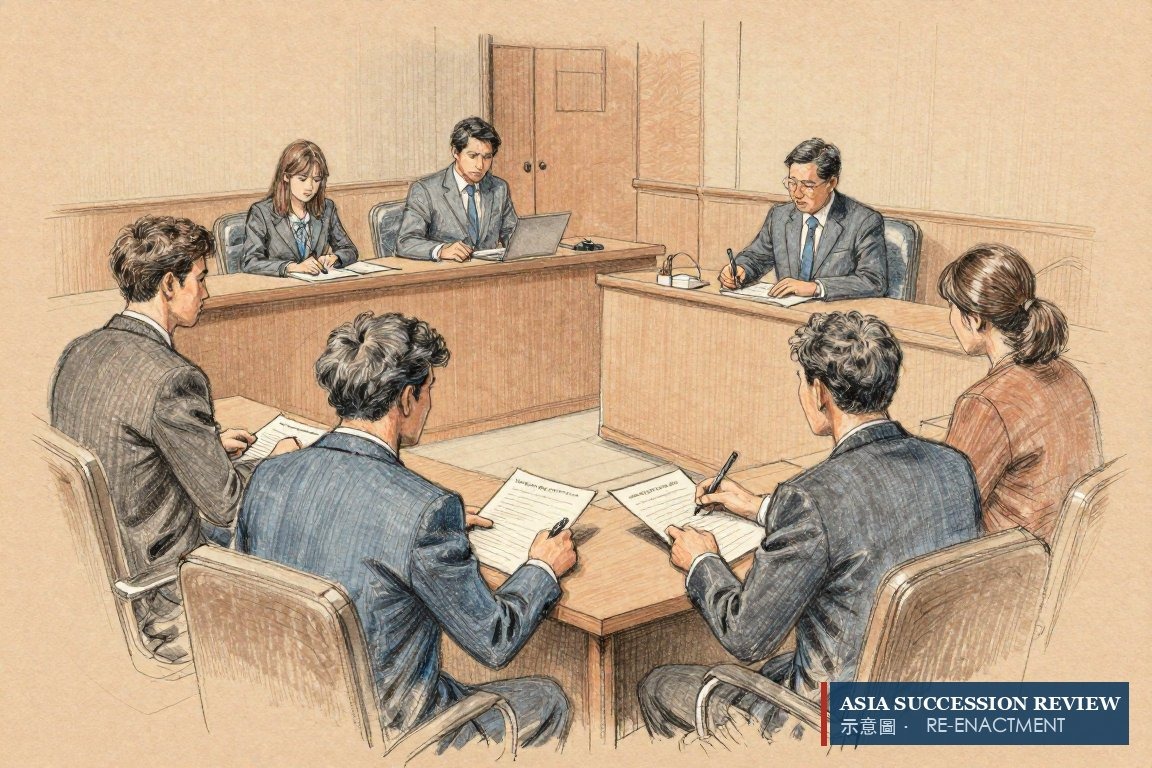
A family charter cannot choose a listed company's chairman, but it decides what the family brings to the boardroom
The honest limits. A family charter cannot bind a listed company's board: the choice of chairman is internal management under the articles, which is precisely what the Hong Kong court held, and no family document changes that in Singapore either. What the charter changes is what the family brings to the board — a decision already taken under a procedure everyone signed, instead of a fight the board must referee in public.
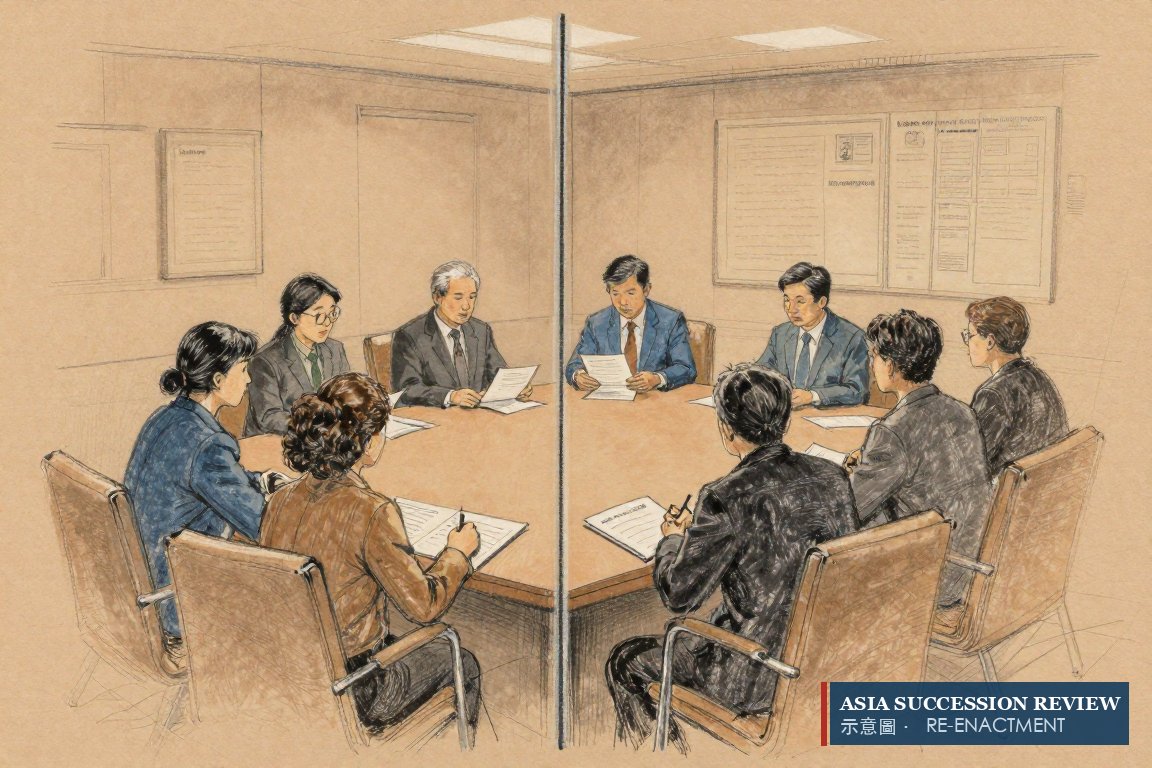
A trustee can still cut a beneficiary out, so the deed must name the grounds before anyone uses them
Nor does a charter stop a trustee removing a beneficiary; that is a power the deed grants, and the answer is not litigation afterwards but a deed that states in advance on what grounds and with whose consent the power may be used. And nothing here touches the criminal law: a corruption prosecution is not a succession event and no structure prevents one. What structure decides is whether, while that is happening, control is somewhere safe.
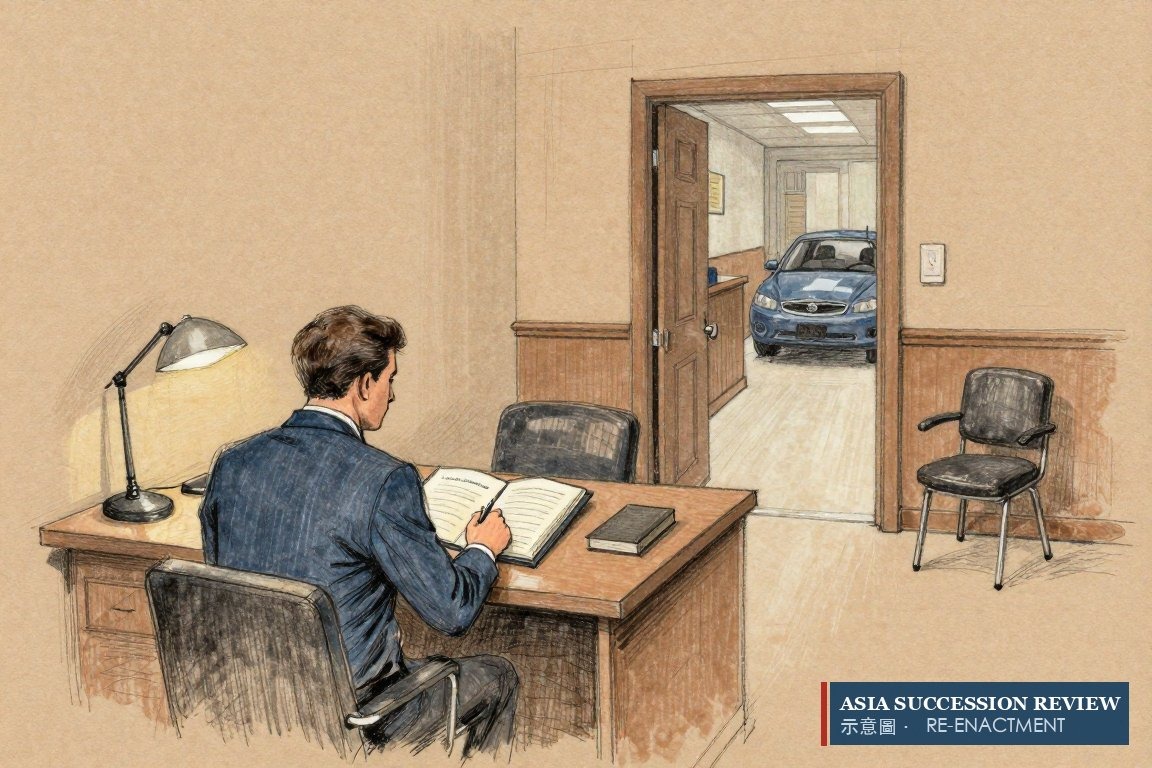
The founder and the widow — the ability to change the plan without a lawsuit — but exercised under written grounds everyone accepted in advance, rather than as a private power discovered in a letter
The brother who is removed — a defined exit at a formula price, funded and payable, instead of six years of standing, reputation and shareholding argued in public
The third generation — an equal, professionally held third each, no estate to administer, and a charter that tells them how the next disagreement gets decided before it happens
A counterfactual, not advice: real structures need licensed hands and your family's facts.
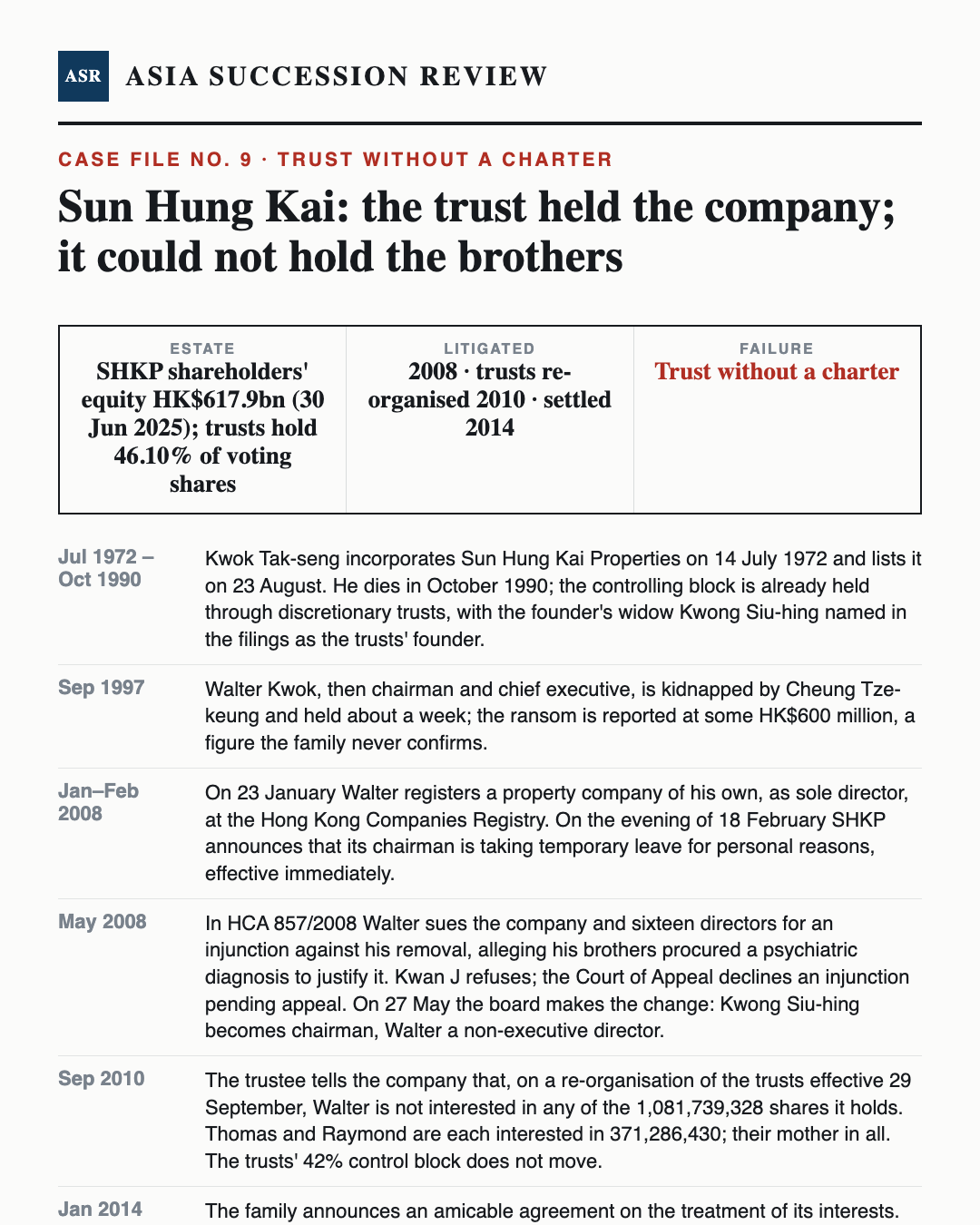
The case in one card — press and hold to save, or forward it as it is.
If your family's shares sit in a trust nobody has explained to you
A discretionary trust is very good at protecting the asset and completely silent about the family. It can add a branch and it can subtract one, and in most deeds the beneficiary learns which has happened by letter. The questions worth asking while everyone is alive, and while they can still be asked as questions: is there anything above the trust — a charter, a family council, a protector — that says how decisions between branches get made; who is named to assess capacity or fitness if it is ever alleged, and who instructs them; is there a priced, funded way for a branch to leave; and does the deed say on what grounds a beneficiary can be removed. What a charter, a fitness protocol, a funded buy-out and a private forum would each change about your position:
Can a family trust remove a beneficiary?
In a discretionary trust, usually yes — the beneficiaries have no fixed entitlement, only the possibility of benefit, and the deed typically gives the trustee or an appointor power to add and exclude. The Kwok family's trusts did exactly that: the trustee told Sun Hung Kai Properties that on a re-organisation effective 29 September 2010 Walter Kwok was not interested in any of the 1,081,739,328 shares it held. No court sat, no share was sold, and the company's 42% control block did not move. The protection for a beneficiary is not a lawsuit afterwards; it is a deed that states in advance on what grounds, and with whose consent, the power may be used.
Can my brothers remove me as chairman of the family company?
If the board has the votes and the articles allow it, yes — and a court will usually not stop them. That is the holding in Walter Kwok's 2008 action against Sun Hung Kai Properties and sixteen of its directors: the choice of a listed company's chairman is a matter of internal management, for the board, and the judge refused an injunction restraining the board from even considering his removal. The Court of Appeal declined to grant one pending appeal. The board made the change on 27 May 2008. Whatever protects a family executive has to sit in a shareholders' agreement or a family charter signed beforehand, not in an application filed after.
What happens to shares held in a family trust when a beneficiary dies?
Nothing, which is the point. Shares held in trust are not part of the beneficiary's estate: there is nothing to value, no grant to wait for, no freeze, no administrator to appoint. When Walter Kwok died on 20 October 2018 no Sun Hung Kai share passed through his estate — by the following June his branch's interests were disclosed in two trusts, one inside the main family structure and one held separately for his sons. Compare the alternative, where a controlling block is owned personally: the register freezes on the death and the family's control is administered by whoever the probate court eventually appoints.
Can a family use a psychiatric or medical assessment to remove someone from the family business?
It happens, and it is one of the ugliest things a family can do to itself, because a report obtained by one side is evidence and an accusation at the same time. Walter Kwok alleged in his 2008 court action that his brothers had procured a diagnosis of bipolar affective disorder as the basis for removing him; the judge found no evidential basis for inferring the directors would act improperly and declined to rule on whether he was fit to be chairman at all. The structural answer is written in advance: a fitness protocol naming how many independent specialists, chosen by whom, instructed by whom, reporting to a protector or family council rather than to a sibling — agreed at a time when nobody knows whose turn it will be.
What is a family charter and does it do anything a trust deed does not?
A trust deed says who owns and who benefits. A family charter says who governs: which decisions need which branches' consent, who may hold which office, how a member exits and at what formula price, how fitness and capacity are assessed, and where disputes go. It is normally not binding on the operating company's board — the board answers to the articles — but it is signed by the people who control the shares, so in practice it decides what the family brings to the board. In the Kwok record the deed did its work for thirty-five years and the missing charter did not: nothing on the file said who decides whether a brother is fit to run the company.
Who controls Sun Hung Kai Properties now, and how much does the Kwok family hold?
As at 30 June 2025 the company disclosed HSBC Trustee (C.I.) Limited, as trustee of certain discretionary trusts, interested in 1,336,019,743 shares — 46.10% of the issued voting shares — with the founder's widow Kwong Siu-hing deemed interested in 28.12% as founder of those trusts, the two figures overlapping. Inside that block, three vehicles hold 12.16% each: Adolfa, identified with Walter Kwok's son Geoffrey; Bertana, with Thomas Kwok's son Adam; and Cyric, with Raymond Kwok and his sons. Walter's branch also holds separately, through a trust whose trustee is disclosed at 8.75%. Raymond Kwok is chairman and managing director.
A question of your own that these don't answer — put it to the desk.
- 1SHKP Annual Report 2007/08 — Directors' Report: 27 May 2008 chairman change; HSBC International Trustee interested in 42.49%
- 2SHKP Annual Report 2010/11 — Directors' Report note: the 29 September 2010 trust re-organisation, in the trustee's own words
- 3SHKP Annual Report 2013/14 — Directors' Report: Walter Kwok disclosed at 7.16% through a separate discretionary trust at 30 June 2014
- 4SHKP Annual Report 2024/25 — Directors' Report: trustee at 46.10%; Adolfa, Bertana and Cyric at 12.16% each (30 June 2025)
- 5ONC Lawyers case note (June 2008) — Kwok Ping Sheung Walter v Sun Hung Kai Properties Ltd, HCA 857/2008
- 6ICAC press release, 14 June 2017 — Court of Final Appeal upholds the misconduct convictions of Rafael Hui and Thomas Kwok