Mustafa Centre: the son who ran the estate also ran the company, for 17 years
Mustafa s/o Majid Khan, a founding partner of the business behind Singapore's Mustafa Centre, died in 2001 without a will. Five months later the company issued his eldest son 4.34 million new shares at S$1 each, and the son became the administrator of his father's estate. His half-siblings found out in 2016. Singapore's courts cancelled the shares, removed him as administrator and made him buy the estate's stake. The price was S$253 million.
Read this in: EN · 简体 · 繁體 · ไทย · ID
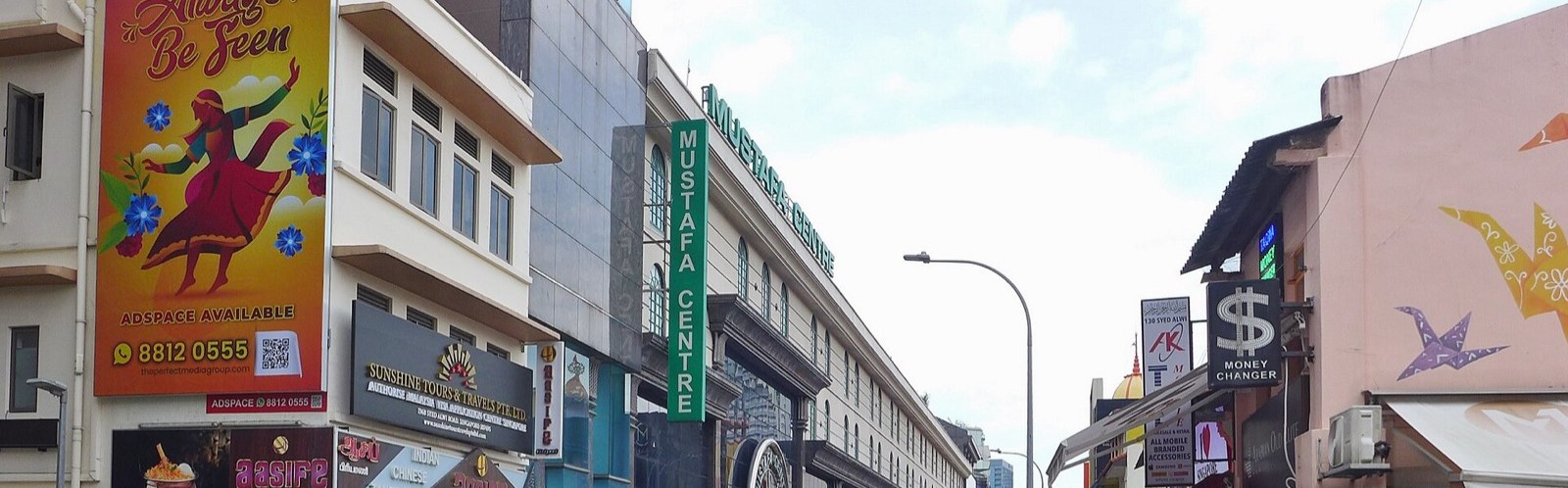
Two partners and one partner's son start a Little India wholesale business in 1973 that grows into Mustafa Centre
Mustafa Centre, the 24-hour department store on Syed Alwi Road in Little India, is run by Mohamed Mustafa & Samsuddin Co Pte Ltd (MMSCPL). The business began as a partnership on 11 July 1973 between Mustafa s/o Majid Khan and Samsuddin s/o Mokhtar Ahmad; Mustafa's eldest son, Mustaq Ahmad, was added that September. The company was incorporated in 1989. That April Mustaq held 51%, Samsuddin 30% and Mustafa 19%, and by 1997 the three held about 43%, 22% and 22%, with Mustaq's wife Ishret Jahan holding the rest.
Five months after the founder dies without a will, his eldest son gets 4.34 million new shares and his father's estate to run
Mustafa died on 17 July 2001, aged 83, without a will. As a Muslim domiciled in Singapore, his estate passed under Muslim law: 80 shares, of which each of four sons, Mustaq among them, took 14, his widow Asia 10, and each of two daughters 7. Five months later, on 11 December 2001, the company allotted Mustaq 4,340,000 new shares at S$1 each. Mustafa's estate fell from 22.07% to 14.89%. Eleven days after that, in Jaunpur, India, his widow and her five children signed a power of attorney drafted on Mustaq's instructions to obtain the grant. He became the sole administrator in 2003.

A half-brother hires a consultant in 2016 and finds the share issues that shrank his father's stake for 15 years
For the next 13 years Mustaq ran the company and administered an estate that owned part of it. He made no distribution. The company paid no dividend until the end of 2013, while directors' fees to Mustaq and Ishret averaged 51% of net profits a year from 2001 to 2014, the heirs pleaded; both courts held the missing dividends and excessive fees oppressive. In 2015 he told his half-brother Ayaz Ahmed the estate held 15%. In 2016 Ayaz hired a consultant, who found the share issues of 1995 and 2001. The family revoked the power of attorney on 1 July 2016 and sued on 8 December 2017.
The son says the business was always his alone, and a Singapore judge rejects the story, revokes his grant and orders a buyout
Mustaq's case was that the business had always been his alone: that he had run his own stall since 1963 and that his father and Samsuddin held their shares for him under oral understandings of 1973 and 2001. Mavis Chionh J, giving judgment in 2021 and written grounds in July 2022, called that account 'a pack of lies'. She cancelled the 1995 and 2001 issues, which restored the estate to 25.4%, held that Mustaq had breached his duties as administrator, revoked his grant and ordered a professional administrator. She refused to wind up a working company and ordered Mustaq and Ishret to buy the estate's shares instead.
A court valuer prices the estate's 25.4 per cent at S$253 million, and the son pays it to his father's heirs, himself among them
The Appellate Division upheld her on 15 May 2024 and told the valuer to credit Mustaq with reasonable directors' fees for building the business. Valuing the company at about S$996.3 million, the valuer put the estate's 25.4% at S$253,070,093. Mustaq and Ishret paid it in two instalments, in August 2024 and June 2025, and paid Samsuddin's estate a similar sum: more than half a billion dollars in all. On 22 October 2026 the High Court dismissed the beneficiaries' challenge to the valuation. Mustaq remains one of the estate's heirs, entitled to 14 of its 80 shares.
The failure was not the son's ambition. It was a structure that left one person on every side of the table. Mustafa had no will and no written agreement on who owned the business he co-founded. When he died, the heir who ran the company became the administrator of an estate that owned part of it: the person who could issue new shares was the person meant to protect the estate from dilution. Nobody else could see the register, so the 2001 issue went unnoticed for 15 years. Singapore's courts repaired it in full, but the repair took nine years and was fought within one father's family, half-brothers on opposite sides.
Write ownership down while every founder is alive, never let the heir who runs the company also hold the estate that owns part of it, and give the other heirs the register and a priced way out.
Singapore's courts repair the whole wrong for the heirs, but the repair costs nine years of half-brothers in court
Start with what the law already did. Singapore's courts gave this family a full remedy. Section 216 of the Companies Act 1967 lets a court cancel a transaction and order a buyout where a company is run oppressively, and s216(7) extends that to people to whom shares have passed by law. Section 32 of the Probate and Administration Act 1934 lets a court revoke a grant 'for any sufficient cause'. All three were used here. The cost was nine years, 20 trial days, an appeal and two further rulings, all between half-brothers.
Founders who sign a shareholders' agreement in 1989 settle who owns what decades before any court must guess
The first fix was available to the founders in 1989: write ownership down. A shareholders' agreement could have recorded who owned what and on what terms, and the constitution could have required new shares to be offered to every holder in proportion. Mustaq's case rested on oral understandings of 1973 and 2001 that both courts rejected. A signed agreement would have settled the question in either direction, decades before a court had to.
A Muslim founder's will cannot change the faraid shares, but naming an independent executor keeps the company's heir from holding the estate alone
The second fix is the will, within the limits Muslim law sets. Section 111 of the Administration of Muslim Law Act 1966 lets a Muslim domiciled in Singapore leave property by will only in accordance with his school of law, which generally limits a bequest to a third and fixes the heirs' shares. A will cannot change the faraid shares, but it can name the executor. Here it could have named a professional or an independent co-executor, so that the heir in control of the company was never alone in control of the estate that owned part of it.
Heirs who see the register and accounts every year question a dilution the year it happens, not 15 years later
The third fix is information. A founder can give the other heirs, by agreement or in the constitution, the right to see the share register, the accounts and any new issue. The 2001 issue was found in 2016 because a consultant looked. Information delivered every year, rather than discovered after 15 years, turns a breach into a question asked the same year.
A buy-sell clause priced by an independent valuer lets the family settle in months what took the courts nine years
The fourth is the exit. The court ordered a buyout because there was no agreed one. A buy-sell clause, with the price set by an independent valuer on a stated method, would have let the estate sell or the family buy within months, at a price fixed before anyone fell out. Be honest about the limits: none of this stops a determined controller, and no plan protects heirs who never ask. What it changes is how quickly a wrong is seen and how cheaply it is put right.
Mustafa's widow and her five children — their faraid shares of the estate's 25.4%, distributed from the start by an administrator with no stake in the company, instead of a share they learned had been diluted in 2016 and recovered in 2024–2025
Mustaq Ahmad, the eldest son — a written record of the ownership he says he built, credit for his work agreed in advance, and 14 of 80 shares as an heir, instead of a story the courts rejected and a buyout of S$253,070,093 at a price he did not set
Ishret Jahan and the family running the company — a business they could run without suits from the other side of the family, and a known price for buying it out
Samsuddin's heirs — the same protections for the co-founder's 30%; their estate was also restored and bought out, for S$256,059,110
Mustafa Centre's staff and customers — a store whose ownership was settled on paper rather than in court, though the court kept it open by refusing a winding-up
A counterfactual, not advice: real structures need licensed hands and your family's facts.
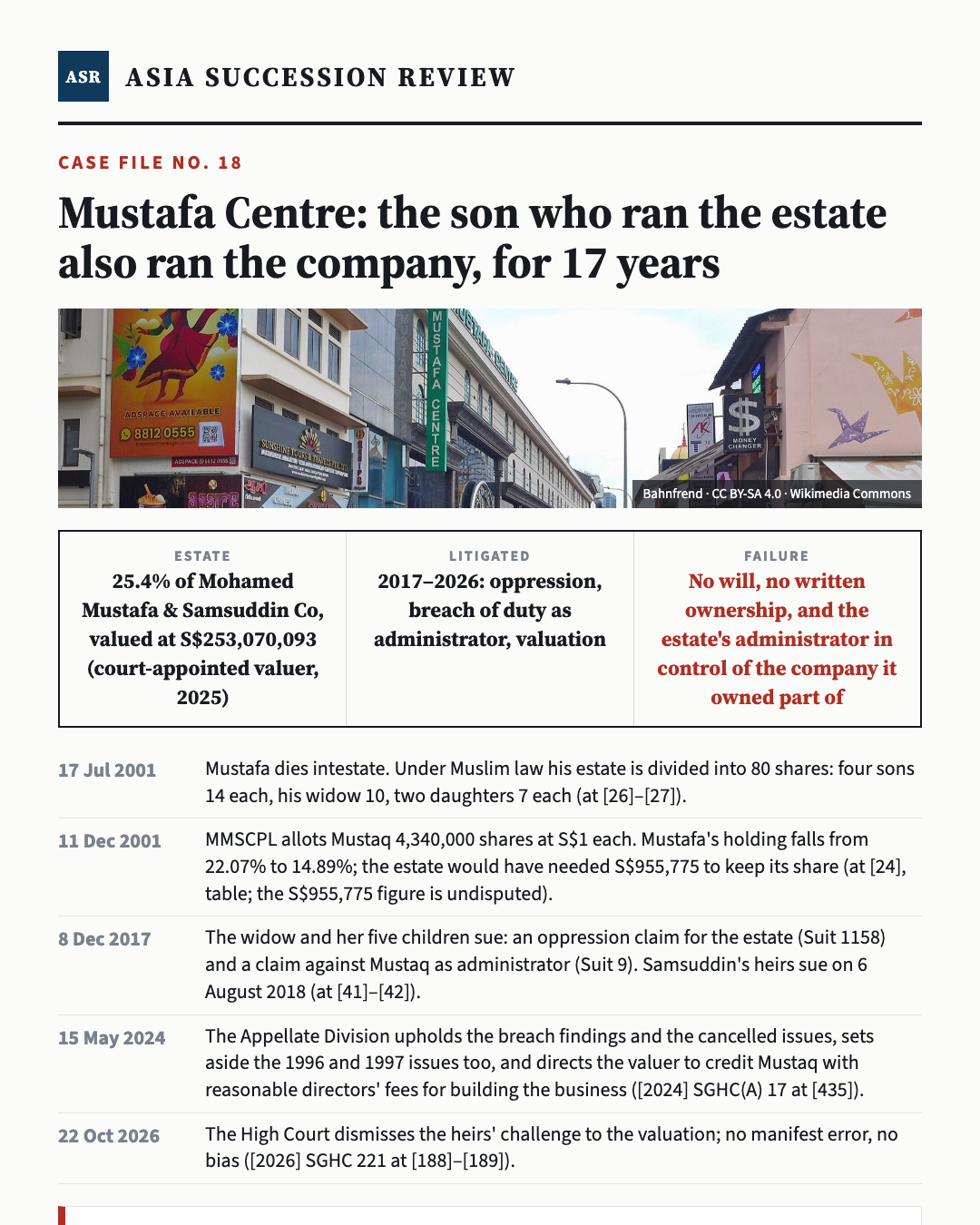
The case in one card — press and hold to save, or forward it as it is.
If one relative runs the business and holds the estate
In many family companies the same person runs the business, keeps the register and, after a death, administers the estate that owns part of it. The questions worth asking while everyone is alive are plain. Is the ownership of the business written down and signed? Who will administer each founder's estate, and do they run the company too? Does every heir see the accounts and every new share issue each year? Is there an agreed way for an heir to sell, with the price set by someone independent? None of this is an accusation. It is how a family makes sure that no single person has to be trusted with everything.
Who owns Mustafa Centre?
Mohamed Mustafa & Samsuddin Co Pte Ltd runs it. Under a 2021 court order, upheld on appeal on 15 May 2024, Mustaq Ahmad and his wife Ishret Jahan bought the 25.4% held by his late father's estate for S$253,070,093 and a similar stake held by co-founder Samsuddin's estate, more than half a billion dollars in all ([2026] SGHC 221).
What was the Mustafa Centre court case about?
Three suits, filed in 2017 and 2018, by the heirs of the two co-founders against Mustaq Ahmad and other directors. The courts found the company had been run oppressively: share issues in 1995 and 2001 diluted the founders' estates, and directors' fees replaced dividends. They cancelled the issues, ordered a buyout and held that Mustaq had breached his duties as administrator and executor ([2022] SGHC 161; [2024] SGHC(A) 17).
Can a court remove the administrator of an estate in Singapore?
Yes. Under s32 of the Probate and Administration Act 1934 a grant may be revoked 'for any sufficient cause'. In the Mustafa estate the court revoked the son's grant after a trial found he had breached his duties, and appointed a professional, Providentia Wealth Management, on 14 January 2022 because the family could not agree on one. Lost confidence alone is a weaker ground.
Can heirs bring an oppression claim if the shares are still in the estate?
Yes, in some cases. Section 216(7) of the Companies Act 1967 applies the oppression remedy to a person to whom shares have passed by operation of law. Here the beneficiaries sued on the estate's behalf because the administrator was himself the alleged wrongdoer, an exception the Appellate Division upheld on 15 May 2024 ([2024] SGHC(A) 17).
Does a Muslim estate in Singapore follow faraid even without a will?
Yes. Under s112 of the Administration of Muslim Law Act 1966 the estate of a Muslim domiciled in Singapore who dies intestate is distributed under Muslim law, and the Syariah Court certifies the shares. Mustafa's estate was divided into 80 shares: 14 to each of four sons, 10 to his widow and 7 to each of two daughters ([2022] SGHC 161).
Can a Muslim in Singapore choose the executor of his will?
Yes. Section 111 of the Administration of Muslim Law Act 1966 requires a will to follow the testator's school of Muslim law, which generally limits bequests to a third and fixes the heirs' shares, but it leaves the Probate and Administration Act 1934 in place. A will can name a professional or independent executor, which is what the Mustafa estate lacked.
Why did the court order a buyout instead of winding up Mustafa Centre's company?
Because winding up is a last resort and the company was operational and successful. Mavis Chionh J followed the Court of Appeal's approach in Lim Swee Khiang v Borden and instead ordered Mustaq and Ishret to buy the estates' shares at a price set by an independent valuer, adjusted for the oppressive acts ([2022] SGHC 161 at [785]).
A question of your own that these don't answer — put it to the desk.
- 1Ayaz Ahmed v Mustaq Ahmad [2022] SGHC 161 (Mavis Chionh J, written grounds 8 July 2022): Suits 1158/2017, 780/2018 and HCF Suit 9/2017; origins, allotment table, intestacy, power of attorney, grant, oppression findings, breach as administrator, revocation and buyout (eLitigation, read in full 14 Nov 2026)
- 2Mustaq Ahmad v Ayaz Ahmed [2024] SGHC(A) 17 (Appellate Division, 15 May 2024; reported [2024] 1 SLR 1016): appeals largely dismissed; 1996 and 1997 issues set aside; directors' fees credit for Mustaq
- 3Ayaz Ahmed v Mustaq Ahmad [2026] SGHC 221 (22 October 2026): valuation challenges dismissed; S$646.7m equity at 16 Aug 2021, S$996.3m after adjustments; S$253,070,093 for the Mustafa estate; payments of 7 Aug 2024 and 26 Jun 2025
- 4Mustaq Ahmad v Providentia Wealth Management [2023] SGHCF 53 and [2023] SGHCF 52 (30 November 2023): professional administrator appointed 14 Jan 2022, letters 26 Dec 2022; interim distribution and disclosure applications dismissed
- 5Companies Act 1967 s216 (oppression; orders to cancel transactions and for purchase of shares; s216(7) transmission by operation of law), Probate and Administration Act 1934 s32 and Administration of Muslim Law Act 1966 ss111, 112 and 115, read on Singapore Statutes Online as at 14 Nov 2026