Adani picked four heirs, not one. Four equals need a tie-breaker
Gautam Adani told Fortune India on 10 November 2026 that his group will pass to four family members together: his sons Karan and Jeet and his nephews Pranav and Sagar. In 2024 he said they would be equal beneficiaries of the family trust. The trust holds 49.67% of the flagship, in the names of Gautam and his brother Rajesh. Equal shares among four people from three branches settle who owns. They do not settle who decides. What the paper has to say, in India or in Singapore.
Read this in: EN · 简体 · 繁體 · ไทย · ID
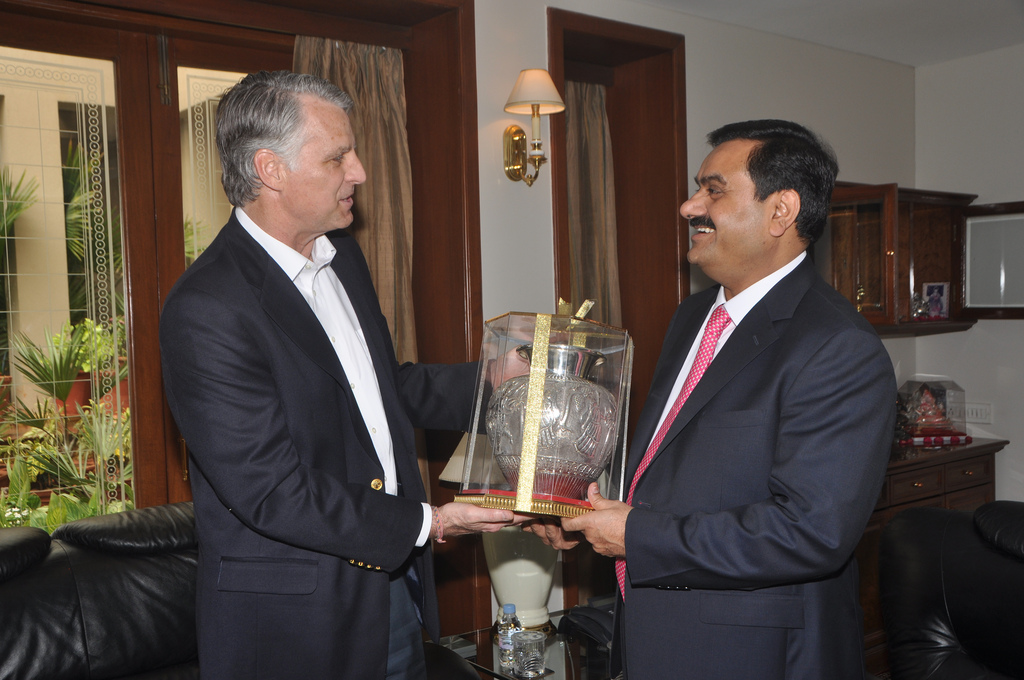
The Adani founder names four relatives to inherit his group together, and leaves the handover with no date
On 10 November 2026 Fortune India published Gautam Adani's answers to an emailed questionnaire about his succession. The founder and chairman of the Adani Group, now 64, said control will pass to four family members together, a team the magazine calls the "G2 leadership": his sons Karan, 39, and Jeet, 29, and his nephews Pranav, 48, son of his elder brother Vinod, and Sagar, 32, son of his brother Rajesh. They are to get full control "at an appropriate time in the coming years". No date was given.
Each of the four heirs already runs a quarter of the group, and the founder names none of them chairman
"The next generation does not inherit leadership. They inherit the responsibility to earn it," Adani told the magazine. He said the four must have the humility to see that "the institution will always be bigger than any individual or family". The interview names no single successor as chairman. Each of the four already runs a part of the group: Karan the ports and cement, Jeet the airports and new businesses, Pranav the agro, oil and gas and the real estate arm, and Sagar the energy companies and the group's finance.
The founder promises his four heirs equal shares of the family trust in 2024, and keeps the transfer terms confidential
The plan is not new in outline. In August 2024 Adani told Bloomberg News that he meant to step down at 70, which falls in 2032, and hand control to the same four. Outlook Business, reporting that interview on 5 August 2024, wrote that the four "will be the equal beneficiaries of the family trust", that a confidential agreement would govern how the stakes pass, and that the four had chosen to run the group together rather than split it. What is new this week is the founder's own description, in writing, of four leaders and no one at the top.
Two founding brothers hold 49.67% of the flagship as trustees, and the filing never says who decides after them
The trust is on the record. In a declaration to the stock exchanges dated 6 April 2026, the promoter group of Adani Enterprises, the flagship, reported holding 74.67% of the company on 31 March 2026. The largest block, 49.67%, is held by "Gautambhai Shantilal Adani and Rajeshbhai Shantilal Adani (on behalf of S.B. Adani Family Trust)". The rest sits in companies, the largest Adani Tradeline with 8.62%. The filing does not say who the beneficiaries are or how the trustees decide.
A dozen listed companies worth about US$181 billion ride on a trust deed nobody outside the family has read
The stakes are large. Fortune India put the group's market value at over ₹17 lakh crore across a dozen listed companies, about US$181 billion at today's rate (our arithmetic), and Adani's own wealth at over US$105 billion. The deed of the S.B. Adani Family Trust and the 2024 agreement are not public. This page reads only what has been said and filed.
- 1Fortune India, 10 Nov 2026: 'Adani Group scripts succession chart with four stars' — Gautam Adani's written answers; Karan, Jeet, Pranav and Sagar as the 'G2 leadership'; full control 'at an appropriate time in the coming years'; ages, roles; group market capitalisation over ₹17 lakh crore; personal wealth over US$105bn
- 2S.B. Adani Family Trust for the promoter group of Adani Enterprises, declaration under SEBI SAST Regulations 2011 reg 31(4), 6 Apr 2026: holding at 31 Mar 2026 — 49.67% by Gautambhai Shantilal Adani and Rajeshbhai Shantilal Adani on behalf of S.B. Adani Family Trust; Adani Tradeline 8.62%; promoter group total 74.67% (NSE archive, read 12 Nov 2026)
- 3Outlook Business, 5 Aug 2024, reporting Adani's interview with Bloomberg News: step down at 70 in the early 2030s; the four 'will be the equal beneficiaries of the family trust'; a confidential agreement on the transfer of stakes; the four chose to run the group together
- 4Supreme Court of India, Hindustan Medical Institution v Birla Corporation Ltd, 2026 INSC 554 (Vikram Nath and Sandeep Mehta JJ, 26 May 2026), paras 13-15: Indian Trusts Act 1882 s48 reproduced ('Co-trustees cannot act singly. When there are more trustees than one, all must join in the execution of the trust, except where the instrument of trust otherwise provides'); the instrument is primary where it provides otherwise (judgment text as hosted by Verdictum, read 12 Nov 2026)
- 5Companies Act 1967 (Singapore), s216(1)-(2): a member may apply to the court where the company's affairs are conducted oppressively or in disregard of his interests; the court may regulate the company's affairs, order a purchase of shares by other members or by the company, or order a winding up; current version as at 12 Nov 2026 on Singapore Statutes Online
- 6Exchange rate: 93.85 rupees to the US dollar, ExchangeRate-API open rates updated 12 Nov 2026; the dollar figure for the market value is our arithmetic
A family hands one group to four equals, and leaves no rule for the day they split two against two
Equal shares answer one question and leave the other open. They say who owns. They do not say who decides. A family that hands a group to four people as equals has to write down, somewhere, what happens on the day two of them want one thing and two want another.
India's Supreme Court rules in May 2026 that a deed overrides unanimity, so a silent deed hands every trustee a veto
Indian law starts from unanimity. Section 48 of the Indian Trusts Act 1882 says that when there is more than one trustee, "all must join in the execution of the trust, except where the instrument of trust otherwise provides". In May 2026 the Supreme Court read that exception as the main point: where the deed sets another rule, the deed governs (Hindustan Medical Institution v Birla Corporation, 2026 INSC 554). So the rule for the Adani trust is whatever its deed says. If the deed is silent, every trustee has a veto.
Whoever replaces the two trustee brothers inherits their votes, and the 2024 agreement on who that is stays secret
Today the trust that holds 49.67% of Adani Enterprises stands in the names of two brothers of the founding generation, Gautam and Rajesh. Whoever replaces them inherits their votes, and the public record does not say who that will be or how it is chosen. The 2024 agreement on how the stakes pass is confidential.
Two of the four heirs are one father's sons, so a family vote can split two against two by branch
The arithmetic of four adds a second problem. Four is an even number, so a vote can split two against two. And the four come from three branches of the family: two are Gautam's sons, one is Vinod's son and one is Rajesh's son. That one father's line holds half of the seats is our reading of the names, not anything the family has said. It is the kind of fact a tie-break clause is written for.
Sun Hung Kai's family trusts hold the company for decades, yet cannot stop the board removing the eldest brother in 2008
The founder's own words point at the gap. He says the four inherit ownership but must earn leadership. That is a sound principle, and it needs a mechanism: someone who decides who has earned it, and what happens to the three who are not chosen when one of them must lead. Hong Kong has run this experiment. The Kwok family's trusts held Sun Hung Kai Properties together for decades, and still could not stop the board removing the eldest brother as chairman in 2008.
In Singapore the same four heirs would need the same thing the Indian deed needs: a written rule for a two-two split, a trustee or protector who breaks the tie, and a line between owning the group equally and running it, because equal shares settle ownership and nothing else.
A Singapore reader checks the law: it cannot move an Indian trust, only show what every deed must say
Limits first. The Adani family is Indian, its companies are listed in India and the S.B. Adani Family Trust is an Indian trust under Indian law. Nothing here suggests that the trust should move, and moving a controlling block of listed Indian shares would raise Indian questions, under the takeover rules and the rules on residents' investments abroad, that we have not examined. The question this page asks is narrower: what any family that gives control to several equal heirs must put in writing, and what Singapore law offers if it does. We read the Singapore section on Singapore Statutes Online on 12 November 2026.
A Singapore deed can give one trustee or a protector the casting vote, so the family never learns the default
The first point is the same in both countries. A trust deed can set its own decision rule. A Singapore deed can say that trustees decide by majority, give one trustee or a protector a casting vote, or require an independent trustee's consent for the largest decisions. We do not assert here what Singapore law does when a deed is silent; the point is that a family should never find out. A deed that is silent on a two-two split leaves the answer to a court.
Four heirs add one independent seat, and an even two-two deadlock becomes a three-two decision
With four heirs, the simplest fix is to stop the count from being even. The trustee can be a company with an odd-numbered board, for example one seat for each of the three branches and one independent director. The trustee can be a licensed trust company (licensed under Singapore's Trust Companies Act 2005), so that a deadlock among the family becomes a question for a professional bound by the deed. Or a protector, named in the deed and replaceable under it, can hold the casting vote. Each choice has a cost, and none of them is advice for this family. Each one answers the question before it is asked.
Four heirs take equal dividends while the board picks one leader, and the loser keeps his quarter
The second fix separates owning from running. A business succession plan has two jobs: to pass the business on properly, and to pay the family fairly. A deed can make the four equal in what they receive, the dividends and the capital, while a board picks the person who leads, by a stated vote, for a stated term, with stated grounds for removal. That is Adani's own principle in written form: equal inheritance, earned leadership. The heir who is not chosen still holds a quarter of the benefit. He has lost an election, not his inheritance.
Feuding owners of a Singapore holding company can win a court-ordered buy-out, at far higher cost than a clause
If the family still falls out, Singapore gives the owners of a holding company a court route. A shareholder whose company is run oppressively, or in disregard of his interests, can ask the court for relief, and the court can regulate the company's affairs, order the others or the company to buy his shares, or wind the company up (Companies Act 1967, section 216). It is a remedy for a fight that has already happened. A buy-sell clause in a shareholders' agreement, with a price formula agreed while everyone is speaking, does the same work for a fraction of the cost.
The founder writes the clauses that replace him while he can explain them, and spares his heirs a fight without a referee
The timing matters as much as the text. In 2024 the founder spoke of stepping down at 70, in the early 2030s. This week's interview gives no date. While he is in the chair, any split among the four has a referee. The clauses that replace him are best written, and tested on a hard case, while he can still explain what he meant. A letter of wishes can say why he chose four. It cannot cast a vote.
An heir asks three questions at the kitchen table, and keeps four equal siblings from becoming four lawsuits
For the reader whose parents are planning to leave a business to several children equally, three questions to ask while everyone is in the room. If we split two against two, who decides? Who replaces a trustee, and who chooses the replacement? And is owning the same as running, or does the paper keep them apart? Asking is not a bid for the chair. It is what keeps four equals from becoming four lawsuits.
Gautam Adani, founder and chairman, 64 — the chair until he hands over 'at an appropriate time in the coming years'; one of the two named holders of the 49.67% trust block in Adani Enterprises
Karan Adani, his elder son, 39 — one of four places in the 'G2 leadership'; runs the ports and cement businesses; managing director of Adani Ports since January 2024
Jeet Adani, his younger son, 29 — one of four places; director of Adani Airport Holdings and in charge of the newer businesses
Pranav Adani, nephew, son of Vinod Adani, 48 — one of four places; the eldest of the four; director of Adani Enterprises, running agro, oil and gas and the real estate arm
Sagar Adani, nephew, son of Rajesh Adani, 32 — one of four places; executive director of Adani Green Energy and in charge of the group's finance
Rajesh Adani, the founder's brother — the second named holder of the trust's 49.67% of Adani Enterprises, on behalf of the S.B. Adani Family Trust
The S.B. Adani Family Trust — 49.67% of the flagship at 31 March 2026; four equal beneficiaries as reported in 2024; a deed and a 2024 agreement that are not public
The same family under a Singapore deed — the same freedom to write the decision rule; an odd-numbered trustee board, a licensed trust company or a protector to break a tie; and, for a holding company, the court's power to order a buy-out or a winding up (Companies Act 1967, section 216)
The reader whose parents plan to leave a business equally — three questions to ask now: who decides a two-two split, who replaces a trustee, and whether owning and running are kept apart
A counterfactual, not advice. The verified machinery is on the Singapore page; where your family stands is the briefing.
From the case files: The trust held the company; it could not hold the brothers: Sun Hung Kai