Great Eagle's family trust never had to keep control, because the deed never said so
羅鷹石 (Lo Ying-shek), founder of Great Eagle and its Langham hotels, put the family's shares into a discretionary trust in 1984. After his death his widow, aged 96, sent the trustee ten letters asking it to buy shares against a son's growing stake. It declined, and in 2019 a Hong Kong court agreed: letters of wishes bind no trustee, and keeping control was never a purpose of the trust. The youngest son's own suit, filed in 2018, is still open.
Read this in: EN · 简体 · 繁體 · ไทย · ID
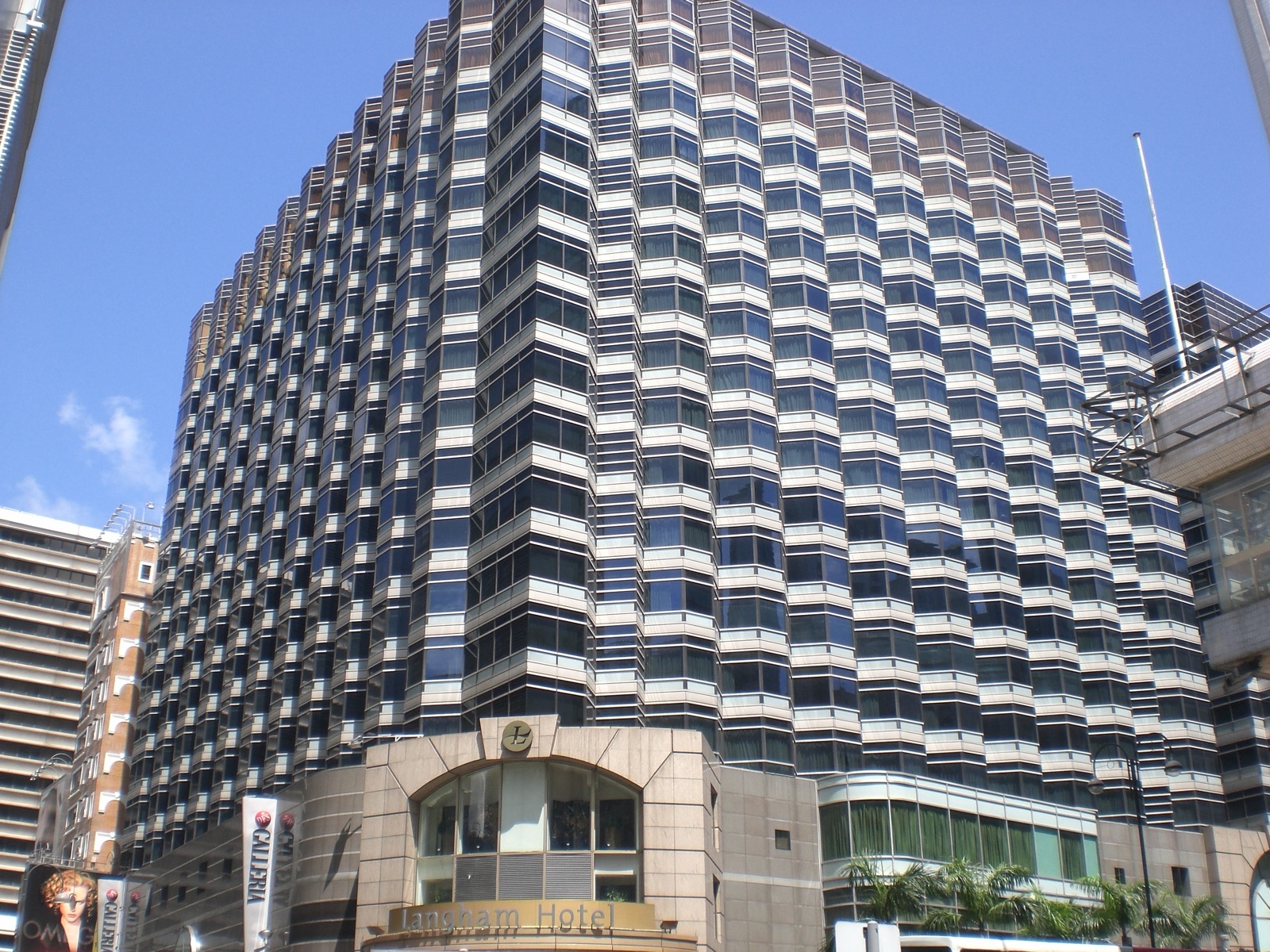
A founding couple put Great Eagle's shares in trust in 1984 and hand control to three of their children
Lo Ying-shek (羅鷹石) founded Great Eagle in 1963; its holding company listed in Hong Kong in 1972, and the group owns The Langham hotels. In 1984 he and his wife, Lo To Lee-kwan (羅杜莉君), settled the family's shares on a discretionary trust for every descendant born within 80 years: nine children and, by 2016, about 90 people. HSBC International Trustee has been trustee since 1999. Since 1998 three children, Nina Law (羅慧端), Lo Ka-shui (羅嘉瑞) and the youngest, Lo Kai-shui (羅啟瑞), have held the offices of appointor and guardian. Those offices, the youngest son himself told the court, were how the founder's wish to keep control was met.
One son sells 55 million shares after his father dies, while his brother the chairman keeps buying
Nothing in the deed obliged the trustee to keep control, the court later found. In July 2004 a family company paid out its Great Eagle shares as a dividend: the trust's stake fell from about 53 to about 33 per cent, and the children's own holdings rose from about 10 to about 30 per cent. The founder died on 1 September 2006. Within a month the youngest son sold about 55 million shares; Lo Ka-shui, the chairman, kept buying. At a family meeting in 2015, by the youngest son's account, Lo Ka-shui said he held 22 per cent and could remove his siblings as directors.

A 96-year-old co-founder writes ten letters, and one brother's refusal keeps the trust's 33 per cent silent
From January 2016 the widow, then 96, sent the trustee ten letters: hand her the whole fund; buy 200,000 Great Eagle shares a day. The trustee consulted the family, proposed nine sub-trusts in December 2016, and bought nothing. She sued. On 10 May 2017 the youngest son lost his seat on the board: of 193.8 million shares voted, about 166.9 million were against him. The trust's 33 per cent cast no vote. Its deed required 30 days' notice to the three guardians; the meeting notice reached the trustee 19 days ahead, and Lo Ka-shui refused to waive it.
A court rules her letters bind no trustee, and the youngest son's own suit waits eight years
On 22 May 2019, after a 33-day trial, the court dismissed her claims. The trustee held an absolute discretion; letters of wishes did not bind it; keeping control of Great Eagle was not a purpose of the trust, which had not controlled a shareholders' meeting since 2004. She withdrew her appeal in December 2020. The youngest son's own suit, filed in February 2018 against the trustee and against his brother as a guardian with a competing stake, was restored on appeal in 2023 and is untried. On 30 June 2026 the trust held 33.97 per cent; Lo Ka-shui's holdings and a trust he founded, 30.26 per cent.
The trust did what its deed allowed, and that is the lesson. The founders' wish to keep Great Eagle in family hands lived in letters of wishes and in a guardian's office shared by three children; neither obliged the trustee to keep control. A letter is a request, so ten of them from a 96-year-old co-founder could be weighed and declined. A guardian's consent is a veto, so one brother's refusal kept the trust's 33 per cent silent at the meeting that removed another. By 30 June 2026 the trust's block and the holdings tied to one guardian sat almost level. Whether that is a conflict has still not been tried.
Write the purpose where the trustee must read it: say what the family block is for, reserve the founders' say instead of requesting it, give the guardians a conflict rule and a majority vote, and make one decision bind every beneficiary.
Singapore saves this family no tax, because Hong Kong stopped charging estate duty in 2006
Start with what Singapore would not change. Hong Kong charges no estate duty on deaths on or after 11 February 2006 (Inland Revenue Department), seven months before the founder died; Singapore removed it for deaths on or after 15 February 2008 (IRAS). The 1984 trust was built chiefly to pass the shares on free of that duty, the 2019 judgment records, so its first reason had gone by the time it was tested. Both places now let a settlor reserve investment powers: Singapore's Trustees Act 1967 s90(5), and Hong Kong's Trustee Ordinance s41X, in force since 1 December 2013. The difference lies in the drafting, not the flag.
A deed that names the shares' purpose tells the trustee what it owes before anyone sues
First, put the purpose in the deed. If the family block is meant to be held as a controlling stake, the deed should say so and tell the trustee not to diversify away from it. A Singapore trustee must weigh diversification only 'insofar as is appropriate to the circumstances of the trust' (Trustees Act 1967 s5(3)(b)), and the statutory duty of care gives way where the trust instrument says so (s3A(2)). Great Eagle's trustee has argued a duty to diversify and avoid concentration risk. A written purpose settles what the trustee owes before anyone has to ask.
Guardians who declare their own stakes and vote by majority stop one refusal from silencing the trust
Second, reserve the say instead of requesting it, and give the guardians rules. A settlor who wants the last word on the shares can reserve that power in the deed (s90(5)); a letter of wishes only asks. In 1984 giving up control was the point of the estate-duty plan; after February 2006 that reason was gone and the deed could have been revisited. Guardians who hold the company's shares themselves should declare it and step out of decisions on that company. Time-critical consents, such as a voting waiver, should pass by majority, and notice periods should fit the company's calendar: the deed asked for 30 days, the trustee had 19.
One proceeding that binds every beneficiary replaces a second lawsuit and a lost decade
Third, make one decision bind everyone. The widow's case and the youngest son's case rest on overlapping facts, and in 2023 the Court of Appeal let the second proceed because he had not been a party to the first, noting that the trustee could have sought to have other beneficiaries represented or notified. A deed that requires the trustee, on any beneficiary's claim, to seek the court's directions with every adult beneficiary joined or represented buys one judgment instead of a decade. None of this decides who should run Great Eagle. It decides how the family argues about it.
羅杜莉君 (Lo To Lee-kwan), co-founder — her wishes for the Great Eagle block written into the deed as a purpose or a reserved power the trustee must follow, instead of ten letters it was entitled to weigh and decline
羅嘉瑞 (Lo Ka-shui), chairman and a guardian — freedom to build his own stake as before, declared, with no say as guardian over the trust's decisions on Great Eagle
羅啟瑞 (Lo Kai-shui), the youngest son and a guardian — the trust's 33 per cent voted at the 2017 meeting under a majority rule, which is a vote and not a guaranteed seat, and one hearing instead of a second suit still open after eight years
The other beneficiaries, about 90 people in 2016 — one judgment that binds them all, and a deed that tells each of them what the family block is for
A counterfactual, not advice: real structures need licensed hands and your family's facts.
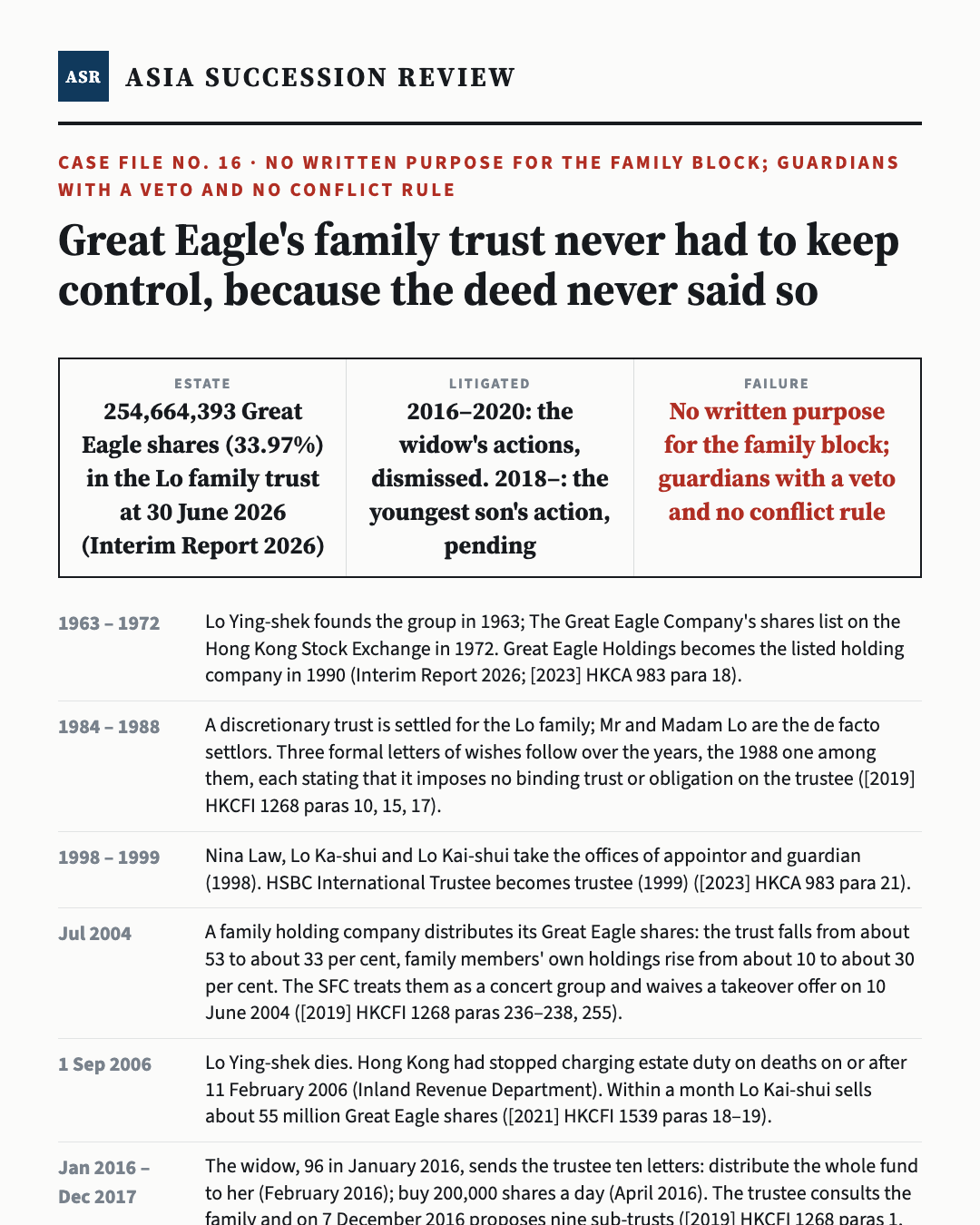
The case in one card — press and hold to save, or forward it as it is.
If your family's control rests on a trust and a letter of wishes
Many Hong Kong and Southeast Asian families hold the company through a discretionary trust and keep the founder's intentions in a letter of wishes. The questions worth settling while everyone is alive are short. Does the deed say what the family block is for, or only that the trustee may do as it thinks fit? Who are the guardians or protectors, and do any of them hold shares of their own? Can one guardian's silence stop the trust from voting? If one beneficiary goes to court, is everyone bound by the answer? Asking is stewardship. A family that writes this down argues once, if at all.
Who controls Great Eagle Holdings in 2026?
No single holder on its own. At 30 June 2026 the Lo family trust, with HSBC International Trustee as trustee, held 254,664,393 shares, 33.97 per cent. Lo Ka-shui, chairman and managing director, held 8.66 per cent personally and 12.81 per cent through his companies, and founded a second trust holding 8.79 per cent: 30.26 per cent in all, Great Eagle's Interim Report 2026 shows.
Why did Lo To Lee-kwan lose her case against HSBC International Trustee?
Because the deed gave the trustee an absolute discretion. On 22 May 2019 the Court of First Instance ([2019] HKCFI 1268) found no understanding that the trustee would follow her instructions, no breach in declining to buy more Great Eagle shares, and that keeping control was not a purpose of the trust. Her appeals were dismissed by consent on 4 December 2020.
Is a letter of wishes legally binding on a trustee?
Not in the Great Eagle case. The founders' letters each said they imposed no binding trust or obligation, and the court treated them as wishes the trustee must consider and may follow, not instructions. A settlor who wants a binding say over investments can reserve it in the deed instead: Singapore's Trustees Act 1967 s90(5), or Hong Kong's Trustee Ordinance s41X since 1 December 2013.
Why did the Lo family trust not vote at Great Eagle's 2017 AGM?
Its deed required 30 days' notice to the appointors and guardians before the trustee voted. The trustee received the meeting notice on 21 April 2017, 19 days before the 10 May meeting, and asked the three guardians to waive the period; Lo Ka-shui refused. The trust's shares were not voted and Lo Kai-shui was not re-elected. The court found no bad faith in the trustee.
What is Lo Kai-shui's lawsuit about, and where does it stand?
Filed on 14 February 2018 (HCA 404/2018), it alleges that the trustee failed to protect the trust's Great Eagle position against his brother's growing stake, and that Lo Ka-shui, as appointor and guardian, had a conflict. These are allegations. Parts were struck out in 2021 and restored on appeal on 18 August 2023; a discovery ruling followed on 17 October 2025. No trial date or judgment appears on HKLII as at 31 October 2026.
What does an appointor and guardian do in a family trust?
The trust deed defines the office; typically it lets named people appoint or remove trustees and consent to certain acts. In the Lo trust three children have held it since 1998, and the deed required 30 days' notice to them before the trustee voted the Great Eagle shares. The office is a check on the trustee. When its holders disagree, it can also work as a veto.
Would a Singapore trust have changed the Great Eagle dispute?
Not by itself. Neither Singapore nor Hong Kong charges estate duty, and both let a settlor reserve investment powers (Trustees Act 1967 s90(5); Trustee Ordinance s41X). What might have changed the outcome is the drafting: a written purpose for the family block, a reserved power instead of letters, guardians with a conflict rule and a majority vote, and one proceeding that binds every beneficiary.
Did Lo Ying-shek's estate pay estate duty in Hong Kong?
Hong Kong charges no estate duty on deaths on or after 11 February 2006, when the Revenue (Abolition of Estate Duty) Ordinance 2005 took effect, the Inland Revenue Department says. He died on 1 September 2006. The 1984 trust, which the 2019 judgment says was set up chiefly to pass the shares on free of estate duty, outlived the tax it was built for.
A question of your own that these don't answer — put it to the desk.
- 1Tao Soh Ngun v HSBC International Trustee Ltd [2019] HKCFI 1268 (HCA 3246/2016, HCA 355/2018; judgment 22 May 2019): the trust's purpose, letters of wishes, the 2004 distribution, the 2017 AGM and the 30-day notice clause; claims dismissed (HKLII)
- 2Lo Kai Shui v HSBC International Trustee Ltd [2021] HKCFI 1539 (HCA 404/2018; 1 June 2021): background, the 2006 share sale, overlapping claims struck out; the widow's appeals dismissed by consent on 4 December 2020 (HKLII)
- 3Lo Kai Shui v HSBC International Trustee Ltd [2023] HKCA 983 (CACV 329/2021 and others; 18 August 2023): nine children, the 1984 trust, appointors and guardians since 1998, the 2017 AGM vote; strike-out set aside, action sent to another judge (HKLII)
- 4Lo Kai Shui v HSBC International Trustee Ltd [2023] HKCA 1328 (6 December 2023): the Court of Appeal's orders on amendments and costs (HKLII)
- 5Lo Kai Shui v HSBC International Trustee Ltd [2025] HKCFI 4876 (HCA 404/2018; 17 October 2025): discovery against the trustee limited; all requests against Lo Ka-shui's side dismissed (HKLII)
- 6HKLII case search for 'Lo Kai Shui', 31 October 2026: eight decisions in HCA 404/2018 and its appeals, the latest dated 17 October 2025
- 7Great Eagle Holdings, Interim Report 2026 (results announced 26 August 2026): directors' and substantial shareholders' interests at 30 June 2026; trust 254,664,393 shares (33.97%); Lo Ka-shui 8.66%, 12.81% and 8.79%; HSBC International Trustee 315,009,622 shares (42.02%); founded 1963, listed 1972
- 8Great Eagle Holdings, Annual Report 2025 (results announced 3 March 2026): Madam Lo To Lee Kwan a non-executive director and co-founder, who did not attend board or general meetings in 2025
- 9Trustees Act 1967, s90: validity of certain trusts, incl. s90(5) reserved powers of investment (Singapore Statutes Online, as at 31 October 2026)
- 10Trustees Act 1967, s5: standard investment criteria, incl. the need for diversification 'insofar as is appropriate to the circumstances of the trust' (Singapore Statutes Online, as at 31 October 2026)
- 11Trustees Act 1967, s3A: trustees' statutory duty of care, excluded where the trust instrument so provides (Singapore Statutes Online, as at 31 October 2026)
- 12Trustee Ordinance (Cap 29), s41X: reserve power of settlor (commencement 1 December 2013) (eLegislation)
- 13Inland Revenue Department (Hong Kong): Revenue (Abolition of Estate Duty) Ordinance 2005 in effect from 11 February 2006
- 14IRAS: estate duty removed for deaths on and after 15 February 2008