What you give in life arrives. What you will waits. Ask Evergreen
Evergreen's founder, 張榮發 (Chang Yung-fa), used every instrument a founder is told to use: two trusts abroad in 2012, outright gifts in 2014, a sealed will leaving everything to his fourth son, 張國煒 (Chang Kuo-wei), and four trusted executives as executors. Three courts upheld the will. Ten years after his death in January 2016, the executors have been unable to distribute the estate, and his own foundation is suing them for NT$1bn.
Read this in: EN · 简体 · 繁體 · ไทย · ID
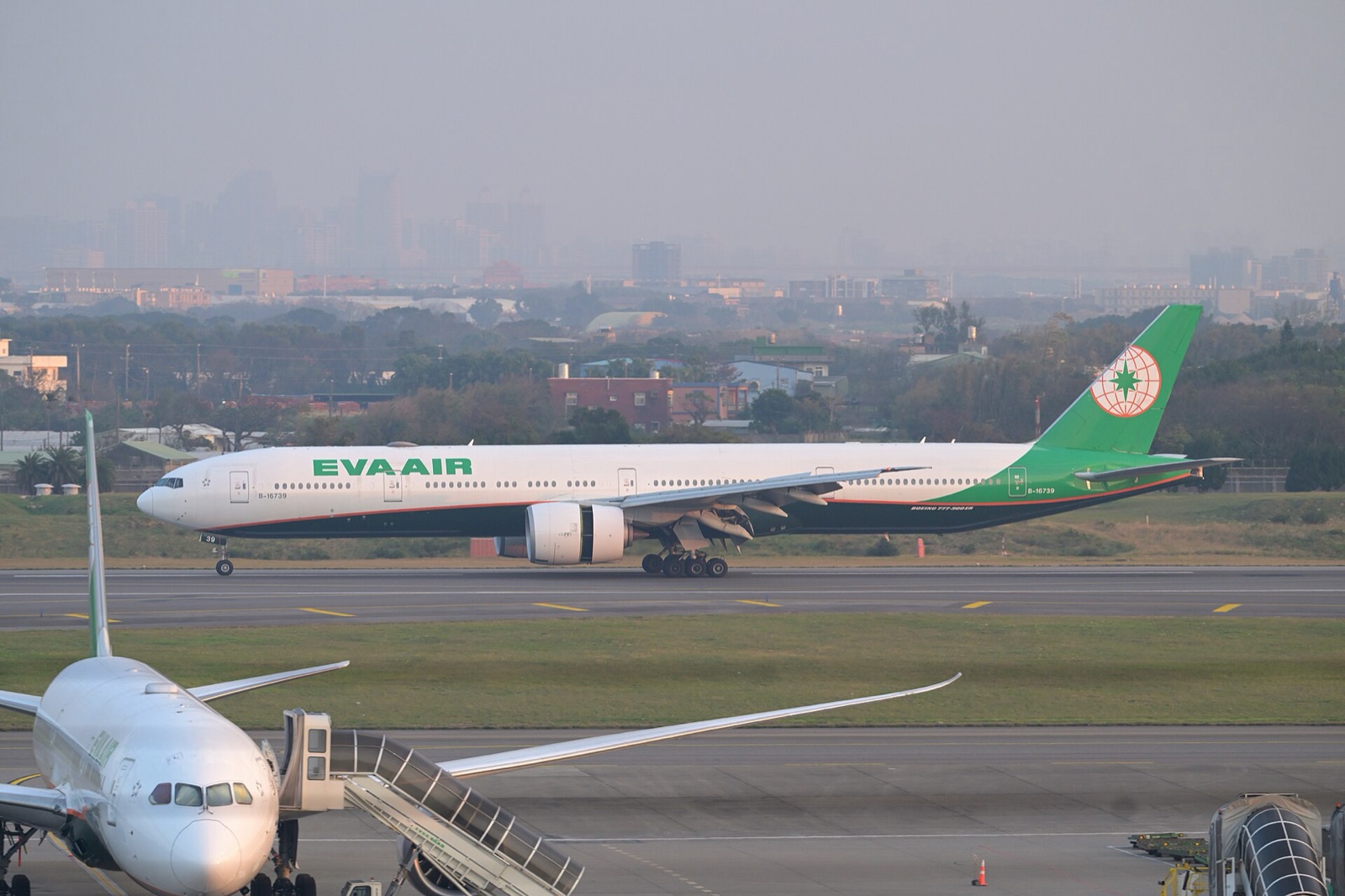
A shipping founder settles a 100-year Singapore trust in 2012, but keeps the power to revoke it
Chang Yung-fa (張榮發) built two of Taiwan's best-known companies: Evergreen Marine, incorporated in September 1968, and EVA Air, incorporated in April 1989, their filings show. In February 2012 he told reporters that his children would receive shares to live on and that his other personal property would go to his foundation (Public Television Service, 8 February 2012). That year he also put money into trust abroad. On 19 June 2012 he settled the Hatsu Trust with OCBC Trustee in Singapore, for 100 years, with its account at Bank of Singapore; on 1 August, a second trust with HSBC International Trustee in Hong Kong, for 150 years.
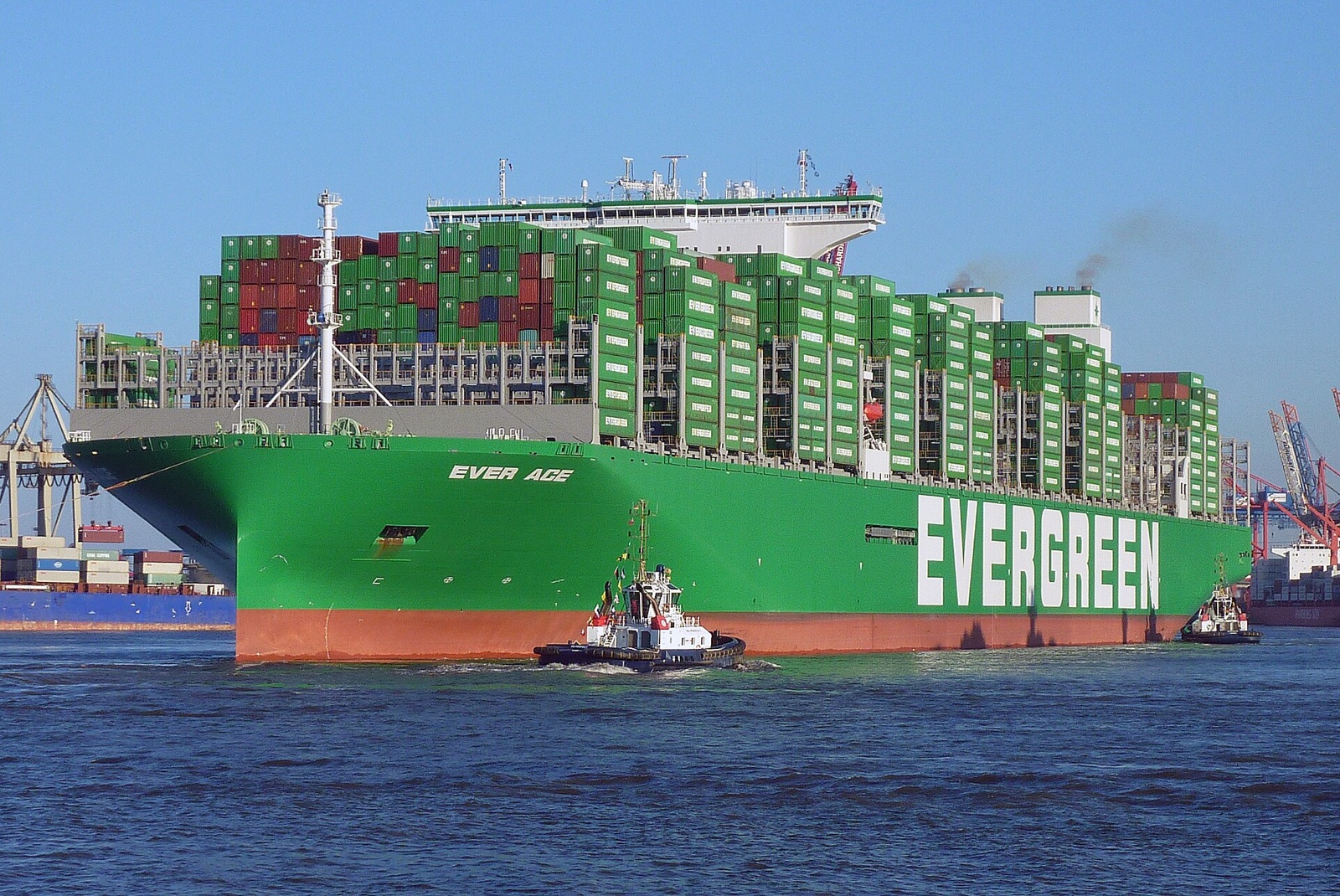
The founder hands his wife NT$100m and a son NT$146.75m in 2014, and both gifts arrive
Both trusts left him in control. He was a beneficiary of the first, and he could revoke either one and remove any beneficiary, the Taipei High Administrative Court later recorded. In October and November 2014 he wrote to both trustees asking that whatever remained after his death go to one son, whom he had made protector; the ruling does not name him. Other gifts that autumn were finished outright. On 30 September and 2 October he gave his wife NT$100m from a bank account; in October and November he transferred half of three British Virgin Islands companies, worth NT$146.75m, to his fourth son, 張國煒 (Chang Kuo-wei).
.jpg)
Four executives witness a sealed will in December 2014, and three Taipei courts uphold it by 2024
Then the will. From November 2014 he dictated it to his secretary, 劉孟芬, a section at a time. On 16 December he signed it at his office before three senior executives, 柯麗卿, 吳界源 and 戴錦銓, and asked the four to be his executors; the next day a notary sealed it at his home. By press accounts it leaves his deposits, shares and property to 張國煒 and asks his children to live in harmony. He died on 20 January 2016, and on 11 March EVA Air's board removed 張國煒 as chairman. His half-brother 張國政 sued to void the will; the courts upheld it in 2020, 2023 and 2024.
The executors pay NT$2.37bn in estate tax in 2022, yet ten years on the estate reaches no heir
Validity settled little. In October 2017 the tax office assessed a gross estate of NT$25.0bn, NT$7.57bn of it the two trusts, taxed as his because he could still undo them; the executors paid the tax in July 2022. In July 2025, with dividends at risk of a five-year time bar, a court ordered the executors to claim them, and the companies paid into an account in the four executors' names. An estate-division suit and 張國煒's application to replace the executors are pending. In March 2026 the Chang Yung-fa Foundation sued the executors for NT$1bn, citing his 2012 memoir. Argument is listed for 22 October 2026.
張榮發 used every instrument a founder is told to use, and finished almost none. What he handed over in 2014, NT$100m to his wife and company shares to a son, arrived. What he kept the power to undo, two trusts worth NT$7.57bn, Taiwan taxed as his estate. What he left by will, the Evergreen shares, three courts upheld, and ten years on the executors have been unable to distribute it. What he promised his foundation in public he never signed, so it is now claimed from his own executors. The question each time was not which document, but whether the transfer was complete while he could still sign.
Finish in 2012 what he began in 2012: an irrevocable Singapore trust holding the Evergreen shares, every household's share fixed with reasons, a notarised gift to the foundation, and a will left with almost nothing to decide.
A Singapore trustee holds his money from 2012, yet Taipei still taxes the whole worldwide estate
Start with what Singapore cannot change. 張榮發 was a Taiwanese national living in Taiwan, so Taiwan taxes his estate wherever it sits (遺產及贈與稅法 art 1), and a Taipei court applies Taiwan's succession law, reserved shares included, to all of it (涉外民事法律適用法 art 58; Civil Code art 1223). Singapore abolished estate duty for deaths on or after 15 February 2008, so there is no Singapore tax to credit: the Taiwanese bill is the whole bill. And he already had a Singapore trustee. The counterfactual is not a trust; it is a finished one. Singapore statutes were read on Singapore Statutes Online on 17 October 2026.
An irrevocable 2012 trust takes the Evergreen shares, and the trustee, not four executors, collects every dividend
First, make the 2012 trust irrevocable and put into it what mattered: the Evergreen shares, or the holding companies above them. A trust expressed to be governed by Singapore law, with Singapore-resident trustees and a settlor who is neither a Singapore citizen nor domiciled there, is shielded in Singapore from foreign inheritance rules (Trustees Act 1967 s90(2)–(3)), and the settlor may keep investment powers (s90(5)). What he could not keep was the power to revoke, or a place among the beneficiaries: those are why Taiwan taxed NT$7.57bn as his estate. A completed transfer is a taxable gift in Taiwan instead (遺產及贈與稅法 art 5-1), settled at the transfer.
The founder writes each household's share and his reasons in 2012, and his heirs read a deed instead of suing
Second, write every household's share into the deed while he could explain it, with his reasons, and do it early: gifts to heirs in the two years before death are added back to the estate for tax (遺產及贈與稅法 art 15), as his 2014 gifts were. Taiwan computes reserved shares on the estate at death plus a short list of earlier gifts to heirs (Civil Code arts 1224, 1173), and lets an heir cut back only gifts made by will (art 1225). Whether a Taipei court would look through a trust built to defeat a reserved share is untested in the rulings read. A trustee, not an executor, collects the dividends.
A notarised 2012 gift delivers the foundation's share, and no NT$1bn claim reaches a Taipei court
Third, give the foundation what he announced, by a deed notarised in 2012. A notarised gift cannot be withdrawn before delivery (Civil Code art 408(2)), and gifts to a registered charitable foundation fall outside gift tax (遺產及贈與稅法 art 20). Then a short will for anything left, valid where the assets sit (Civil Code art 1189; Wills Act 1838 s6), with an executor who sits on no claimant's board. The honest limits: Taiwanese shares stay under Taiwanese company law, the tax bill is unchanged, children keep a reserved half after the August 2026 amendment, and a document signed in late 2014 would have met the same capacity challenge as the will.
張國煒, the son named in the will — shares held by a trustee for him from the day the deed was signed, instead of a will upheld in 2024 and an estate that has still not reached him in 2026
The other heirs — a stated share and the reasons for it, written while their father could explain them, instead of a reserved-share claim fought through a division suit
The Chang Yung-fa Foundation — a notarised gift delivered in his lifetime and outside gift tax, instead of a NT$1bn claim resting on a line in his memoir
The four executors — a short residual will and no seat on a claimant's board, instead of ten years holding dividends between heirs, a foundation and a court order to collect
A counterfactual, not advice: real structures need licensed hands and your family's facts.
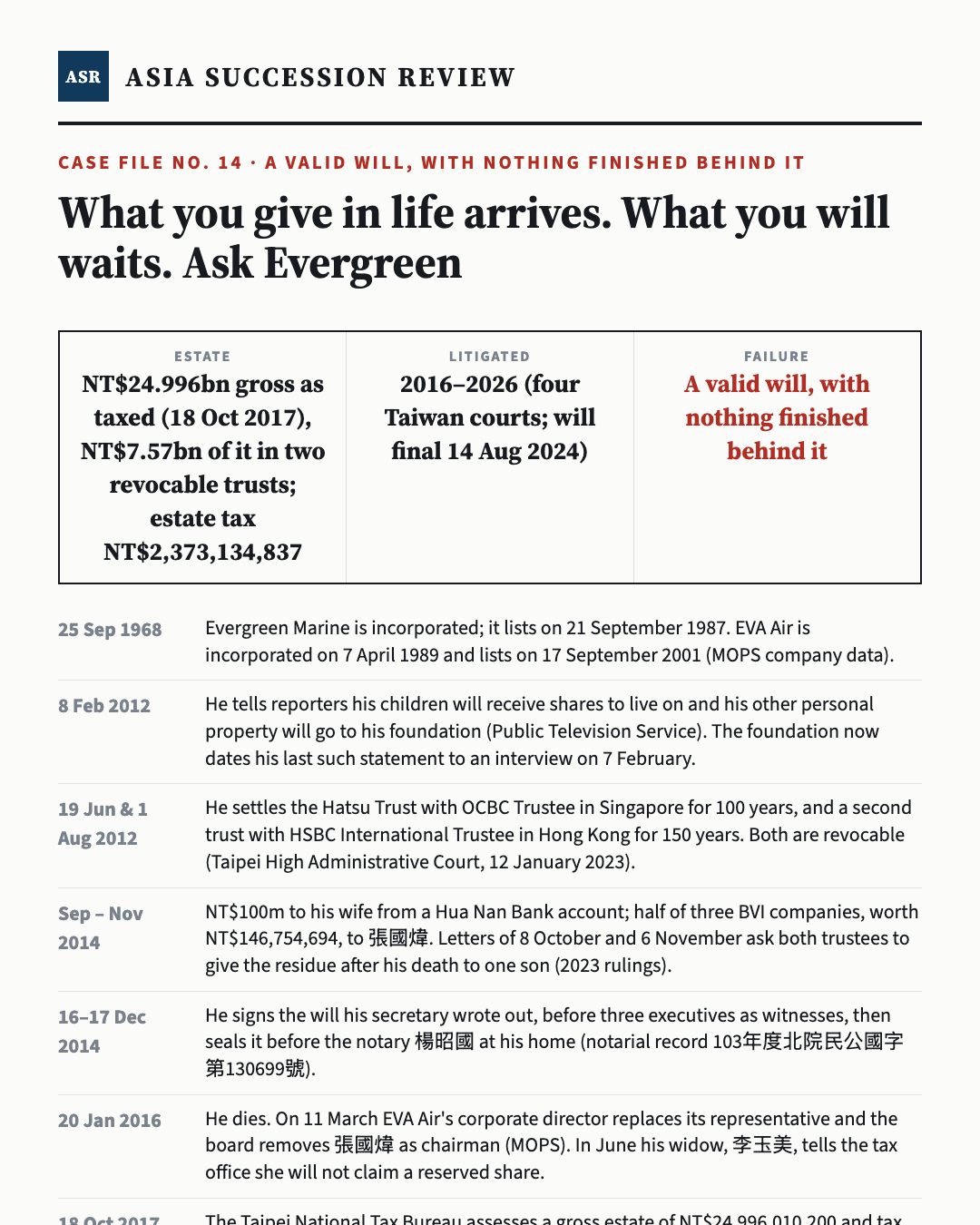
The case in one card — press and hold to save, or forward it as it is.
If your family's plan is a will, a letter of wishes and a promise
Many Taiwanese founders have done what this one did: a trust abroad they can still revoke, a will in a sealed envelope, a public pledge to the family foundation. Each is reasonable; none is finished. The questions worth settling while everyone is alive are plain. Which assets have actually moved, and which only have instructions? Could the trust still be undone, and does the tax office therefore count it as estate? If the will is challenged, who collects the dividends meanwhile? Is any promise to a foundation on paper? Asking is stewardship. The answers decide whether the next decade is spent running the companies or waiting for a court.
What did 張榮發's (Chang Yung-fa's) will say?
It is a sealed will (密封遺囑) signed on 16 December 2014 and sealed before a notary at his home on 17 December. By press accounts it leaves his deposits, shares and real property to his fourth son, 張國煒, and asks his children to live in harmony; a witness told the court it also named 張國煒 to succeed him as group chairman, assisted by four vice-presidents. It names four executors: 柯麗卿, 劉孟芬, 吳界源 and 戴錦銓.
Did the courts find 張榮發's will valid?
Yes, three times. His third son, 張國政, argued that his father lacked capacity, did not sign, and did not designate the witnesses before the notary. The Taipei District Court dismissed the claim on 16 March 2020, the Taiwan High Court on 25 April 2023, and the Supreme Court on 14 August 2024 (112年度台上字第1764號). The courts found capacity partly in his large gifts of autumn 2014.
Why has 張國煒 not received the estate ten years later?
Because validity was only the first question. The other children keep reserved shares, an estate-division suit is pending, and the executors cannot distribute while it runs, the eldest son told a court in April 2026. Courts refused in 2023 to replace the executors while the will was on appeal; 張國煒's second application, filed in 2024, was still pending in April 2026. Meanwhile the dividends sit in an account in the four executors' names.
How large is the reserved share (特留分) of 張榮發's other children?
Half of the statutory share. In July 2018 the court valued 張國政's claim on a statutory share of one-sixth and a reserved share of one-twelfth (107年度重家繼訴字第18號). His widow, 李玉美, told the tax office in June 2016 that she would not claim hers. The Civil Code amendment promulgated on 17 August 2026 removes siblings' reserved shares; children keep half.
Why is the Chang Yung-fa Foundation suing the executors?
It says his public statements, the last an interview on 7 February 2012, and a line in his 2012 memoir that all his remaining money would go to the foundation, made a gift upon death. It claims NT$1bn from the executors (115年度重訴字第227號). 張國煒 and his mother joined the case; their counsel argues the 2014 will revoked any earlier gift. Argument is listed for 22 October 2026.
Did 張榮發 have a trust in Singapore?
Yes. On 19 June 2012 he settled the Hatsu Trust with OCBC Trustee, now BOS Trustee, in Singapore, for 100 years, and on 1 August 2012 a second trust with HSBC International Trustee in Hong Kong. Both were revocable. Taiwan's tax office valued them at NT$2,872,937,436 and NT$4,698,408,595 and taxed both as his estate; the Taipei High Administrative Court upheld that on 12 January 2023.
How much estate tax did 張榮發's estate pay?
The Taipei National Tax Bureau assessed a gross estate of NT$24,996,010,200 on 18 October 2017, and tax of NT$2,405,482,085 at the flat 10 per cent then in force. After reconsideration the bill was NT$2,373,134,837 on a net estate of NT$24,291,196,048 (109年度訴字第1025號). The executors paid in full on 20 July 2022, 張國煒 told a court.
Would a Singapore trust have prevented the Evergreen dispute?
Not the one he had. His 2012 trusts were revocable and kept him among the beneficiaries, so Taiwan taxed them as his estate. One that might have helped is a trust made irrevocable while he was well, holding the Evergreen shares, with each household's share fixed. It would not have reduced Taiwan's tax, and a Taipei court could still be asked to apply reserved shares to anything left in his name.
A question of your own that these don't answer — put it to the desk.
- 1Taipei District Court, 107年度重家繼訴字第18號 civil judgment, 16 March 2020: 張國政 v 張國煒, claim to void the sealed will of 17 December 2014 dismissed; witness evidence of the dictation, signing and sealing
- 2Taipei District Court, 107年度重家繼訴字第18號 ruling, 5 July 2018: claim valued on a one-sixth statutory share and a one-twelfth reserved share
- 3Taiwan High Court, 109年度重家上字第47號 civil judgment, 25 April 2023: appeal dismissed; capacity shown partly by the 2014 gifts (NT$100m to his wife; BVI company shares worth NT$146,754,694 to 張國煒); the will's contents per a witness
- 4Supreme Court, 112年度台上字第1764號 civil judgment, 14 August 2024: appeal dismissed; the sealed will valid under Civil Code art 1192(1); death on 20 January 2016
- 5Taipei High Administrative Court, 109年度訴字第1025號 judgment, 12 January 2023: 張國政 v Taipei National Tax Bureau; the 2012 Hatsu trusts (OCBC Trustee, Singapore; HSBC International Trustee, Hong Kong) revocable and taxed as estate at NT$2,872,937,436 and NT$4,698,408,595; assessment of 18 October 2017
- 6Taipei District Court, 112年度司繼字第322號 ruling, 21 July 2023: 張國煒's application to replace the four executors dismissed while the will's validity was on appeal
- 7Taipei District Court, 112年度家聲抗字第99號 ruling, 19 September 2023: appeal dismissed; estate tax paid by the executors on 20 July 2022 (applicant's account)
- 8Supreme Court, 112年度台簡抗字第318號 ruling, 27 December 2023: further appeal on the executors dismissed
- 9Taipei District Court, 114年度司家暫字第1號 ruling, 16 July 2025: executors ordered to claim dividends unpaid since 20 January 2016 from Evergreen Marine, EVA Air, Evergreen International Storage & Transport and Evergreen International (five-year limitation, Civil Code art 126)
- 10Taipei District Court, 114年度執事聲字第525號 ruling, 15 August 2025: enforcement of the dividend order remitted
- 11Taiwan High Court, 114年度家抗字第65號 ruling, 20 January 2026: the four companies have paid; cash into an account in the executors' names; stock dividends to a holding account because executors cannot open a joint securities account
- 12Taipei District Court, 115年度司家聲字第50號 ruling, 20 April 2026: 張國華 may read the executor file (113年度司繼字第2669號); the executors unable to distribute while the division suit is pending
- 13Taipei District Court, 115年度重訴字第227號 ruling, 20 July 2026: Chang Yung-fa Foundation v the four executors (delivery of a gift); 李玉美's June 2016 letter declining a reserved share
- 14Taipei District Court, 115年度重訴字第227號 ruling, 8 September 2026: 張國煒's intervention stands; hearings of 14 May and 2 July 2026
- 15Taipei District Court, 110年度聲判字第86號 ruling, 22 July 2021: 張國政's application to prosecute the notary refused
- 16Taipei District Court, 109年度訴字第3099號 judgment, 16 June 2021: the foundation's eleventh board, listing 柯麗卿, 戴錦銓 and 劉孟芬 among its directors
- 17MOPS: EVA Air (2618) company data — incorporated 7 April 1989, listed 17 September 2001
- 18MOPS: Evergreen Marine (2603) company data — incorporated 25 September 1968, listed 21 September 1987
- 19MOPS: STARLUX Airlines (2646) company data — incorporated 2 May 2018, listed 25 October 2024, chairman 張國煒
- 20MOPS: EVA Air, 20 January 2016 — death of 張榮發, representative of a corporate director
- 21MOPS: EVA Air, 11 March 2016 — 張國煒 removed as chairman, 林寶水 elected
- 22Civil Code (Taiwan), art 1192: sealed wills
- 23Civil Code (Taiwan), art 1223: reserved shares, as amended and promulgated on 17 August 2026, in force six months later
- 24Civil Code (Taiwan), art 1224: the reserved share computed on the estate under art 1173, less debts
- 25Civil Code (Taiwan), art 1225: reduction of testamentary gifts
- 26Civil Code (Taiwan), art 1215: the executor's duties
- 27Civil Code (Taiwan), art 408: revocation of a gift before delivery, not available for a notarised gift
- 28Act Governing the Choice of Law in Civil Matters Involving Foreign Elements (涉外民事法律適用法), art 58
- 29Estate and Gift Tax Act (遺產及贈與稅法), art 1: worldwide estate of a national living in Taiwan
- 30Estate and Gift Tax Act, art 5-1: a trust for others is a gift
- 31Estate and Gift Tax Act, art 15: gifts to heirs within two years of death added back to the estate
- 32Estate and Gift Tax Act, art 20: gifts to registered charitable foundations excluded from gift tax
- 33Trustees Act 1967, s90: validity of certain trusts (Singapore Statutes Online, as at 17 October 2026)
- 34Wills Act 1838, s6: formalities of a will (Singapore Statutes Online, as at 17 October 2026)
- 35Inheritance (Family Provision) Act 1966, s3: maintenance claims, only where the deceased dies domiciled in Singapore (Singapore Statutes Online, as at 17 October 2026)
- 36IRAS: estate duty removed for deaths on and after 15 February 2008
- 37Public Television Service (公視), 8 February 2012: 張榮發 says his children get shares and his personal property goes to charity
- 38CNA (中央社), 18 March 2020: first-instance judgment; the will's wording as reported by Mirror Media
- 39CNA, 12 January 2023: the estate-tax judgment; the heirs listed
- 40Next Apple (壹蘋), 2 July 2026: the foundation's suit filed in March 2026; the widow's waiver of her reserved share; the NT$1bn claim (press)
- 41UDN (經濟日報), 27 August 2026: third hearing; NT$1bn claim; argument listed for 22 October 2026
- 42SETN (三立), 27 August 2026: the 2012 memoir line and the 7 February 2012 interview relied on by the foundation
- 43Peoplenews (民報), 31 August 2026: why the will has distributed nothing; the widow's division suit and the overseas-estate argument (press)